Access

- Submit your institution’s Sharing Information on Progress (SIP) Report
- Access SIP reporting across institutions

Access
Access

History
In 2008, a group of universities and business schools formed a dedicated Working Group to address the integration of the UN Global Compact’s anti-corruption principle into academic and business discourse. Following the publication of an initial guidance report, the group has expanded to include additional member institutions and has become a dynamic community working together to promote integrity and combat corruption in the public, private, academic and third sectors.
Purpose
The Working Group focuses on key challenges of corruption, defined by Transparency International as “the misuse of entrusted power for private gain.” Corruption is recognized as one of the world’s greatest challenges. It is a major obstacle to sustainable development because it diverts resources from their proper use. It has a significant impact on the private sector, preventing the promotion of necessary competition between large and small brands, leading to the creation of monopolies that not only harm consumers, but also pose serious legal and reputational risks. This undermines the integrity of everyone involved and damages the fabric of organizations and society.
Goals
The main goals of the PRME Working Group on Anti-Corruption are to:
Address the needs of the business community in implementing the 10th principle of the UN Global Compact.
Develop curriculum and teaching methods for including anti-corruption subject matter in business and liberal arts curricula at business schools and universities
The Working Group has the goals to collaborate in the following ways:
Corporate Collective Action- Promote integrity pacts and collective action among leading companies in different sectors. These initiatives follow recognized best practice and are implemented through individual and sector-wide projects in collaboration with local and international business chambers.
Joint Conferences and Initiatives- In collaboration with global business ethics organizations and networks – including platforms such as the World Economic Forum’s Partnering Against Corruption Initiative (PACI), promote joint conferences and initiatives that foster the exchange of experiences and increase the collective impact of anti-corruption efforts.
Network Opportunities- Support local and regional networks to bring together academics, professionals and institutions committed to ethics, compliance and integrity. These networks also provide peer exchange opportunities for senior executives (CEOs, CFOs, COs) through workshops, webinars and face-to-face meetings, fostering practical dialogue and shared learning.
The Working Group promotes research and knowledge dissemination with a practical focus on business ethics, integrity and transparency, with the goal of contextualizing the discussion of these issues in each specific geographic region and providing practitioners with concrete tools to help them establish, enhance, and monitor effective ethics and compliance programs.
Working Group members actively contribute to the academic conversation through the publication of journal articles, books, educational materials, and case studies. The Working Group’s publications are part of the broader PRME book series, helping to shape thought leadership in responsible management education.
Global Dialogues and Conferences:
The Working Group organizes global dialogues and conferences to bring together stakeholders to explore critical issues in responsible management education. Conferences, webinars and academic events serve as platforms for dialogue, knowledge sharing and showcasing progress in integrating anti-corruption into university and business school curricula.
Collaborative Online Events:
The Working Group also focuses on collaboration and partnership with stakeholders across the UN system and other international organizations, the private, academic and third sectors to expand its reach and impact. For example, since 2021, the Integrity Talk Series – a quarterly webinar format – has sought to bring together engaged scholars and practitioners from around the world to share and discuss current trends and challenges in combating corruption and promoting integrity. To learn more about past and future Integrity Talks, please visit the following website.
Collaborative Curriculum Development:
The Working Group focuses on developing best practice guidelines and promoting curriculum change that integrates a business ethics approach with compliance as a fundamental component. The goal is to drive curriculum change through a two-pronged strategy. The vertical strategy focuses on stand-alone business ethics modules in open programs. These include lectures (with case studies, technical notes, etc.), presentations by experienced practitioners, discussions of ethical dilemmas with compliance officers, and short programs on evolving best practices in ethics and compliance. The horizontal strategy integrates business ethics into existing courses, such as governance and strategy topics (including stakeholder and trust theories) in business policy courses, and ethics and compliance risk as part of enterprise risk management (ERM) in finance courses.
The Working Group develops a comprehensive anti-corruption toolkit, piloted in several institutions, assists educators in integrating anti-corruption issues into their teaching. The toolkit is continuously refined based on user feedback and new pedagogical insights.
Stay tuned for additional resources to be uploaded in the resources tab!
Examples of previous resources developed by the working group and its members:
Watch the Anti-Corruption in Management Curriculum Speed Draw Video
Anti-corruption guidelines ('Toolkit') for MBA curriculum change
Stachowicz-Stanusch, A., Amann, W., Hauser, C., Kleinhempel, M., & Tripathi, S. (Eds.). (2025). Organizational Corruption, Crime and Covid-19: Upholding Integrity and Transparency in Times of Crisis. Oxford: Taylor & Francis Group/Routledge. https://doi.org/10.4324/9781003427933
Hauser, C., & Amann, W. (Eds.). (2023). The Future of Responsible Management Education: University Leadership and the Digital Transformation Challenge. Cham: Springer International Publishing. https://doi.org/10.1007/978-3-.. .
Hauser, C., & Ryan, A. (2021). Higher education institutions, PRME and partnerships for the goals: retrofit labeling or driving force for change? Sustainability Accounting, Management and Policy Journal, 12, 1268–1288. https://doi.org/10.1108/SAMPJ-.. .
Hauser, C. (2020). From Preaching to Behavioral Change: Fostering Ethics and Compliance Learning in the Workplace. Journal of Business Ethics, 162, 835–855. https://doi.org/10.1007/s10551.. .
Hauser, C. (2019). Reflecting on the role of universities in the fight against corruption. RAUSP Management Journal, 54, 4–13. https://doi.org/10.1108/RAUSP-.. .
Stachowicz-Stanusch, A., & Amann, W. (Eds.). (2019). Anti-corruption in management research and business school classrooms. Information Age Publishing.
Stachowicz-Stanusch, A., & Amann, W. (Eds.). (2019). Mastering anti-corruption: The practitioners' view. Information Age Publishing.
Amann, W., & Stachowicz-Stanusch, A. (2018). Viral nature of corruption in a world of business and academia. Organization & Management Scientific Quarterly, 4(44), 43–57.
Amann, W., Berenbeim, R., Tan, T. K., Kleinhempel, M., Lewis, A., Nieffer, R., Stachowicz-Stanusch, A., & Tripathi, S. (2017). Anti-corruption: implementing curriculum change in management education. Routledge. https://doi.org/10.4324/9781351284400
Amann, W., & Stachowicz-Stanusch, A. (Eds.). (2013). Integrity in organizations: Building the foundations for humanistic management. Palgrave Macmillan.
Stachowicz-Stanusch, A., & Amann, W. (Eds.). (2012). Business integrity in practice: Insights from international case studies. Business Expert Press.
Chair
Professor Dr Christian Hauser, PRME Business Integrity Action Center, University of Applied Sciences of the Grisons; Switzerland.
Christian.Hauser@fhgr.ch
Steering Committee
Chair/Integrity Talk Series: Christian Hauser
Anti-Corruption Policy Lead: Agata Stachowicz-Stanusch
Research Communication (Website): Ajai Prakash
Webinars/Events Lead: Eduard Ivanov
Research Communication (Newsletter): Jose Godinez
Mentoring Lead: Matthias Kleinhempel
Partnership Lead: Rasha Kassem
Fundraising Lead: Shiv Tripathi
Research Lead: Wolfgang Amann
Please fill out the form here to receive emails regarding opportunities from this Working Group as they arise.
If you can not access google forms to join or have a question about this Working Group, you may reach out to the chair Christian.Hauser@fhgr.ch.
For general queries, contact info@unprme.org.

Corruption is recognised to be one of the world’s greatest challenges. It is a major obstacle to sustainable development, diverting resources from their proper use, and has considerable negative impact on the private sector and society on the whole. This video provides an overview of corruption, the role of higher education institutions in addressing it, and resources available from the PRME Working Group on Anti-Corruption.

The PRME Working Group on Anti-Corruption, supported through the Siemens Integrity Initiative, has developed a PRME Anti-Corruption Toolkit, which provides comprehensive guidelines for anti-corruption curriculum change, including eleven modules with background reading material, detailed case discussions, and an array of primary sources and scenarios. The modules can be used individually or as a stand-alone MBA course on anti-corruption. The aim of the Toolkit is to address the ethical, moral, and practical challenges that students may face in the marketplace. Visit this free open source Toolkit to access content, suggest changes or updates to existing material, or contribute new resources.
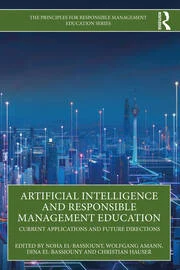
Artificial Intelligence (AI) offers considerable opportunities, as well as challenges, to management education and research. This book brings together case studies and best practice examples of the use of AI in advancing diverse fields relating to Responsible Management Education (RME). The book identifies the real-world application of AI and showcases exemplary policies related to AI and its role in advancing responsible management in higher education institutions. Interesting cases include the development of curricula, AI-powered personalized learning, the implications of using AI in short-answer grading, and the utilization of AI in auditing and investment.
El-Bassiouny, N., Amann, W., El-Bassiouny, D., & Hauser, C. (Eds.). (2025). Artificial Intelligence and Responsible Management Education: Current Applications and Future Directions (1st ed.). Routledge. doi.org/10.4324/9781003660286
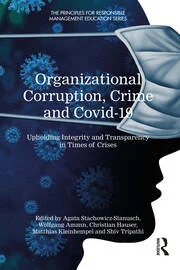
Corruption often flourishes in times of uncertainty and crisis. When institutions and oversight are weak, and public trust low, corruption can thrive and undermine how societies respond to the crisis. This book, created by the PRME Working Group on Anti-Corruption, brings together top international experts to consolidate the lessons from the Covid-19 crisis in order to improve transparency, integrity, trust, and governance in the future. Cybersecurity and cybercrime related to the pandemic are a particular focus. Practice-oriented, each chapter offers examples of methods, approaches, tools, and cases which can be used for anti-corruption teaching, policy, and corporate initiatives.
Stachowicz-Stanusch, A., Amann, W., Hauser, C., Kleinhempel, M., & Tripathi, S. (Eds.). (2024). Organizational Corruption, Crime and Covid-19: Upholding Integrity and Transparency in Times of Crises (1st ed.). Routledge. https://doi.org/10.4324/9781003427933
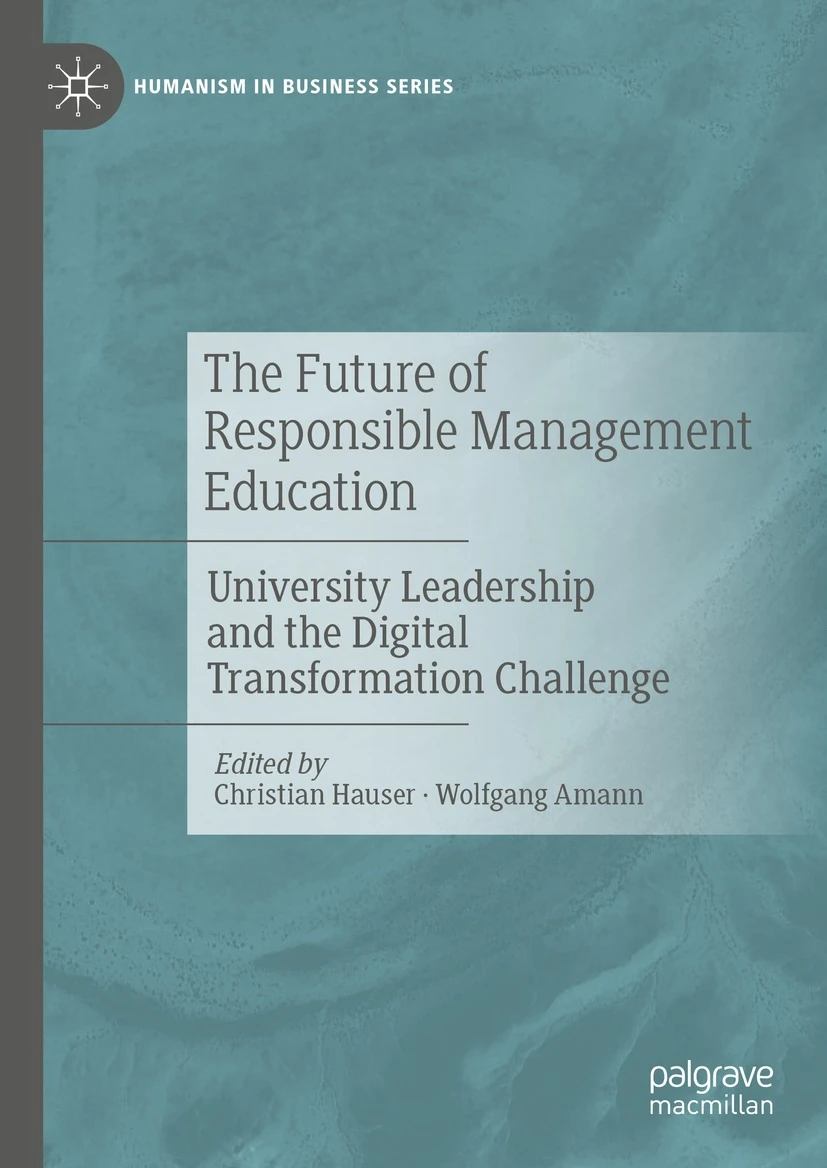
This book applies the lens of responsible management education on the digital transformation challenge. It brings together international scholars and experts in a comprehensive volume. The book covers both content and delivery methods, better preparing individuals and organizations for digital transformation.
Hauser, C., & Amann, W. (Eds.). (2023). The Future of Responsible Management Education: University Leadership and the Digital Transformation Challenge. Cham: Springer International Publishing. https://doi.org/10.1007/978-3-031-15632-8

This paper aims to propose a framework to map partnerships as practiced in higher education institutions (HEIs) and trace the current mode of engagement between HEIs and their partners. This paper reflects on the alignment between current practices and what is understood in the literature as “true” partnerships. We are interested in the different modes of engagement that are labeled by the HEIs as partnerships and consider the plasticity of the term. The interest is in how the term is operationalized by HEIs and how variations in approach can be accounted for while still maintaining some stability and common understanding of the term partnership.
Hauser, C., & Ryan, A. (2021). Higher education institutions, PRME and partnerships for the goals: retrofit labeling or driving force for change? Sustainability Accounting, Management and Policy Journal, 12, 1268–1288. https://doi.org/10.1108/SAMPJ-...
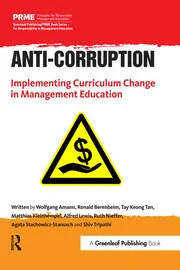
This publication provides resources for building trust through the implementation of comprehensive guidelines on how to professionalize ethics and anti-corruption education worldwide in a variety of classroom settings. It is written and tested by highly experienced program directors, deans and professors, in how to adopt, adapt and develop best teaching practice. It highlights successful patterns, details illustrative case studies and offers clear, hands-on recommendations.
Amann, W., Berenbeim, R., Tan, T. K., Kleinhempel, M., Lewis, A., Nieffer, R., Stachowicz-Stanusch, A., & Tripathi, S. (2017). Anti-corruption: implementing curriculum change in management education. Routledge. https://doi.org/10.4324/9781351284400

The quest for integrity in business is not only a reaction against malfeasance in business and associated calls for reform but also a search that stems from changes and new demands in the global business environment, including increased expectations for corporations and business leaders to address global challenges. This book presents and critically discusses key case studies from all over the world, offering essential insights, practical advice, and guidance for any business leader wishing to lead an organization with reliable and proven integrity. The authors provide valuable research results as well as real teaching tools for faculty and students.
Stachowicz-Stanusch, A., & Amann, W. (Eds.). (2012). Business integrity in practice: Insights from international case studies. Business Expert Press
Reflecting on the role of universities in the fight against corruption
The purpose of this paper is to provide a good practice example of how universities and business schools can take actions to align themselves with the international sustainability and anticorruption agenda.
Hauser, C. (2019). Reflecting on the role of universities in the fight against corruption. RAUSP Management Journal, 54, 4–13. https://doi.org/10.1108/RAUSP-....
From Preaching to Behavioral Change: Fostering Ethics and Compliance Learning in the Workplace
This paper addresses the formative, developmental question of how companies’ ethics and compliance training programs should be organized in a manner that enhances their potential to be effective. Drawing on both the qualitative analysis of existing ethics and compliance training and the conceptual literature on behavioral ethics, a framework is proposed that consecutively aligns various types of training into a comprehensive ethics and compliance training program. The strengths and limitations of the suggested framework are discussed.
Hauser, C. From Preaching to Behavioral Change: Fostering Ethics and Compliance Learning in the Workplace. J Bus Ethics 162, 835–855 (2020). https://doi.org/10.1007/s10551...
Anti-corruption in management research and business school classrooms
This book aims at presenting the topic of anti-corruption activities throughout management research as well as in the process of educating future business leaders and practitioners in business schools in different parts of the globe. Simultaneously the book deepens the topic of anti-corruption in selected cultures and societies. The volume consists of four parts, “Introduction”, “Teaching business ethics and anti-corruption—across curriculum and beyond”, “Fostering integrity in higher education”, and “Anti-corruption as a topic of research.” This book is authored by a range of international scientists and experts in management research and management education, with a diversity of cultural and professional backgrounds.
Stachowicz-Stanusch, A., & Amann, W. (Eds.). (2019). Anti-corruption in management research and business school classrooms. Information Age Publishing.
Viral nature of corruption in a world of business and academia
This paper aims to shed a light on viral nature of corruption and its influence on integrity in the academic community by presenting a particular set of academic community's behaviors that are destructive for its integrity as well as by presenting a universal set of instruments and methods for preventing both the higher education sector as well as business sector from corruption diffusion.
Amann, W., & Stachowicz-Stanusch, A. (2018). Viral nature of corruption in a world of business and academia. Organization & Management Scientific Quarterly, 4(44), 43–57.
Integrity in organizations: Building the foundations for humanistic management
This book goes beyond the call for more humanistic management in the aftermath of a series of corporate scandals and the recent financial crisis, and offers advice on how we can build more humanistic organizations with the help of integrity. The authors shed light on leadership, governance and further implementation issues.
Amann, W., & Stachowicz-Stanusch, A. (Eds.). (2013). Integrity in organizations: Building the foundations for humanistic management. Palgrave Macmillan.
No events found