Access

- Submit your institution’s Sharing Information on Progress (SIP) Report
- Access SIP reporting across institutions

Access
Access

 New York, United States
Share


Recognizing the collective potential of more than three million students across its Signatory Members, PRME established PRME Students as a global platform to empower the next generation of responsible leaders. Today, the community connects student organizations worldwide, creating opportunities for students to develop the skills, networks, and mindsets needed to shape a more sustainable future.
Through three interconnected pillars: Advocacy & Representation, Skills Development & Entrepreneurship, and Career Readiness, PRME Students aims to equip emerging leaders to amplify youth voices, turn ideas into action, and build meaningful pathways into responsible careers.
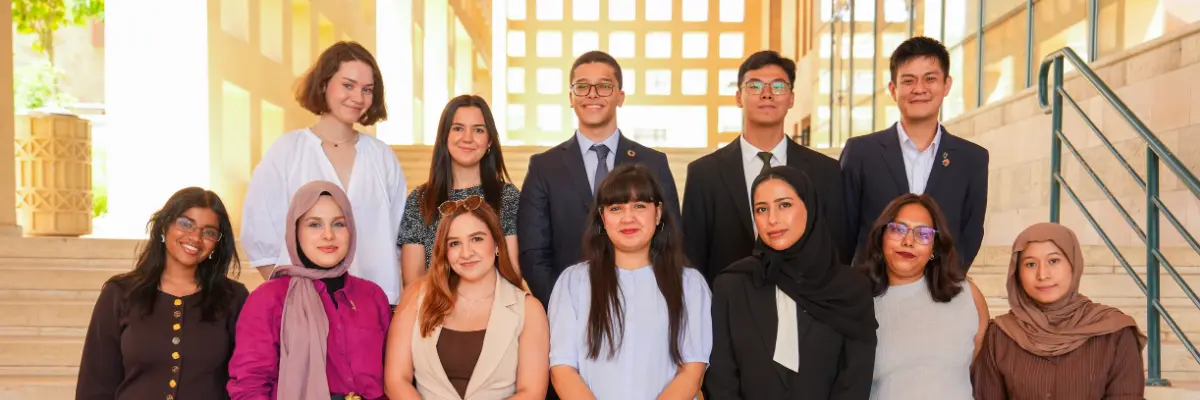
At the heart of this global movement are the PRME Students Regional Leaders. Representing nine world regions, these student leaders serve a one-year mandate to connect sustainability-oriented student organizations, organize regional events and initiatives, represent youth perspectives at high-level global forums, and strengthen the bridge between higher education, industry, and the United Nations system.
As the 2025–2026 cohort concludes its term, Regional Leaders reflect on their experiences and the impact they hope to carry forward.
The Advocacy & Representation pillar empowers Regional Leaders to elevate student voices in conversations on responsible management education and the Sustainable Development Goals (SDGs). Throughout the year, Regional Leaders represented their regions in global forums, connected with like-minded peers and institutional leaders, and demonstrated that young people are not simply participants in these conversations—they are active contributors.
For Fatima Ewaz, a student at Balochistan University of Information Technology, Engineering and Management Sciences, representing South and Central Asia, that meant recognizing that advocacy does not require access to large platforms or significant resources. After connecting with fellow student leaders through PRME, she joined a sustainability-focused organization and began using photography and videography to document climate issues in her region. She incorporated those visuals into awareness sessions designed to help people recognize sustainability challenges within their own communities.
The experience showed her how something as accessible as an image could become a tool for advocacy. "Once I saw how a photograph or a short video could make someone stop and actually see a problem they'd been overlooking, I understood that my voice, even without many resources behind it, could genuinely shift how people thought and acted on responsible management and sustainability."
Serving as a Regional Leader also expanded how Fatima thought about representation itself. Rather than focusing only on her immediate surroundings, she began considering the needs of her region more broadly, particularly water scarcity and drought in Balochistan, Pakistan, and access to quality education and institutional curricula for students in underserved communities.
That shift transformed representation from simply speaking on behalf of her region into a responsibility to act on the challenges facing it. "This role taught me that impact does not always require large resources or perfect circumstances. It requires consistency and a genuine willingness to keep showing up for your region even when the platform feels bigger than you."
That sense of agency was reflected across the cohort. For Magdalena Zaczek, a student at the Stockholm School of Economics, representing Europe, engaging directly with senior leaders reinforced the value of bringing student perspectives into global conversations.
“Having the opportunity to engage directly with UN Global Compact Leaders showed me that young people are not only invited to the conversation, we can genuinely shape it. Those discussions reinforced that our perspectives are valued and can influence how responsible management and sustainability are approached.”
The Skills Development & Entrepreneurship pillar enables Regional Leaders to develop practical capabilities by organizing initiatives, managing projects, engaging stakeholders, and collaborating across sectors and cultures.
For Ian Abuki Mose, a student at Strathmore University, representing Africa, that experience took shape through an SDG sensitization campaign in Mukuru Kayaba, an informal settlement in Nairobi, Kenya. The initiative was developed to bridge the gap between global conversations around the SDGs and the everyday realities of communities experiencing challenges such as flooding, poor sanitation, environmental degradation, and limited access to clean water.
As one of the project organizers, Ian helped mobilize volunteers, coordinate logistics and facilitators, manage timelines, and bring together participants from different sectors and countries. The experience allowed him to put project management and stakeholder engagement skills into practice. "Effective leadership is about creating an environment where different people can contribute their expertise toward a shared goal."
By working directly with community leaders and youth representatives from Mukuru, Ian and his team grounded the campaign in residents' lived experiences and priorities rather than approaching the community with predetermined solutions. "By combining technical knowledge with local experience, we developed a campaign that was both relevant and more likely to have a lasting impact."
For Ian, the experience demonstrated that addressing complex sustainability challenges requires more than technical knowledge. It requires the ability to coordinate diverse stakeholders, build trust, manage projects, and translate ambitious ideas into solutions rooted in the communities they are intended to serve. It has also opened new opportunities for Ian to apply these skills beyond the campaign, including exploring partnership opportunities with United Nations Global Compact companies through connections with Sanda Ojiambo, CEO and Executive Director of the UN Global Compact, and Chichi Bodart, Chief of Staff of the UN Global Compact.
Other Regional Leaders similarly reflected on how being trusted with responsibility strengthened their ability to transform ideas. For Hassa Khalid Almujyish, a student at the College of Business Administration, Princess Nourah Bint Abdulrahman University, representing the Middle East, the programme created an environment where student representation went beyond simply being invited into the conversation. “Whenever I shared an idea, raised a concern, or proposed a new approach, I felt that my perspective was genuinely valued. More importantly, I wasn’t just listened to—I was trusted to help turn those ideas into action.”
The Career Readiness pillar prepares Regional Leaders to navigate the transition from university into careers advancing responsible business and sustainable development.
For Mansi Kaushik, a student at the Fortune Institute of International Business (FIIB), representing South and Central Asia, the programme broadened both her understanding of responsible leadership and her vision for the future.
"Before this role, I viewed sustainability mainly through environmental initiatives. Working with students, educators, and professionals from different countries helped me understand that responsible leadership is equally about inclusion, collaboration, ethical decision-making, and ensuring diverse voices are part of the conversation."
Participating in the PRME Student Summit in Cairo and the United Nations General Assembly in New York connected Mansi with fellow Regional Leaders, UN professionals, educators, policymakers, and students from around the world. These experiences expanded her professional network while exposing her to the different ways people and institutions approach shared sustainability challenges.
"The relationships I built through PRME continue to inspire me. I leave this role with a strong international network that I know will continue to shape both my personal growth and my commitment to responsible management."
The experience also helped Mansi clarify where she hopes to make an impact after graduation. She plans to stay connected to initiatives that bring together young people, universities, businesses, and policymakers to address sustainability challenges, with a particular interest in making responsible management more practical and accessible for future leaders.
For Novia Kusherawati, a student at the School of Business and Management, Institut Teknologi Bandung (ITB), representing East and Southeast Asia, the programme similarly helped bridge the gap between learning about responsible leadership and putting it into practice.
“Being a PRME Students Regional Leader has broadened my theoretical knowledge of responsible leadership to its practical application in the experience of working across cultures, disciplines, and sectors.”
The 2025–2026 PRME Students Regional Leaders have strengthened student engagement across regions, elevated youth voices in global conversations, and demonstrated the important role students play in advancing responsible management education.
Explore some of the other contributions and achievements of the PRME Students Regional Leader Cohort:
Contributing to a PRME–UNESCO IESALC Workshop in Malaysia.
Organizing a COP30 programme, engaging over 1,200 students from over 100 countries, both within and beyond the PRME community.
Meeting with Sanda Ojiambo, CEO and Executive Director of the United Nations Global Compact, to reflect on their one-year term.
Organizing and contributing to the first-ever PRME Student Summit, including leading outreach, supporting programming, and moderating sessions.
Thank you to all 2025–2026 PRME Students Regional Leaders:
Bassel Mohamed Ali Deghaidy, The British University in Egypt, Egypt
Ian Abuki Mose, Strathmore University, Kenya
Novia Kusherawati, School of Business and Management – ITB, Indonesia
Shanaz Salma Jeelani, Business School at Murdoch University, Australia
Abulkhan Alimkhan Bagdatuly, Narxoz University, Kazakhstan
Büşra Celayar, Sakarya University, Türkiye
Magdalena Zaczek, Stockholm School of Economics, Sweden
Sophie Scott, Ulster University in Belfast, United Kingdom
Gabriel Eduardo Fonseca Carrasquero, Instituto de Estudios Superiores de Administración (IESA), Venezuela
Vanessa Félix Mendoza, CETYS University, Mexico
Eva Amer Slika, Suliman S. Olayan School of Business, The American University of Beirut, Lebanon
Hassa Khalid Almujyish, College of Business Administration, Princess Nourah Bint Abdulrahman University, Saudi Arabia
Hao-Yu (Justin) Chu, Seneca Faculty of Business, Canada
Meghan White, Gordon S. Lang School of Business and Economics, University of Guelph, Canada
Shruti Tamilselvan, University of Sydney Business School, Australia
Thejani Wickrama Hewage, Business School, University of Canterbury, New Zealand
Fatima Ewaz, Balochistan University of Information Technology, Engineering and Management Sciences Quetta, Pakistan
Mansi Kaushik, Fortune Institute of International Business (FIIB), India
Share
New York, United States
14 Regions Reunite for PRME’s 7th Annual Global Chapter Forum
 New York, United States
PRME at UNGA81: Connecting Business Education, Finance and Leadership for Systems Change
 Ontario, Canada
Signatory Spotlight: Yorkville University, Canada