Access

- Submit your institution’s Sharing Information on Progress (SIP) Report
- Access SIP reporting across institutions

Access
Access

 New York, United States
Share


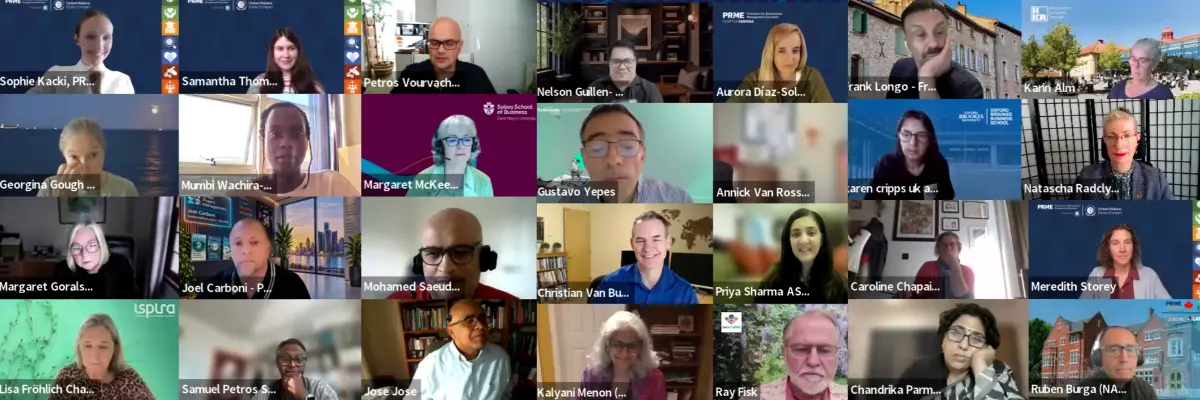
The Principles for Responsible Management Education (PRME) community gathered virtually for the 7th Annual Global Chapter Forum, bringing together Chapter leadership and Steering Committee members, the PRME Secretariat, United Nations Global Compact leadership, and partners from across the global network.
The Forum provided a collaborative, cross-regional space for participants to exchange ideas, share expertise, and identify new opportunities to advance responsible management education through research, partnerships, and regional engagement. Building on conversations from the 2026 PRME Global Forum in Cairo, the event demonstrated the importance of connecting global priorities with local action and strengthening collaboration across PRME's growing network.
Opening the Forum, Dr. David Steingard, Head of PRME, welcomed participants and recognized the dedication of the Chapter community. Reflecting on the diverse expertise and shared commitment across the network, he highlighted the community as a place where passion, intellect, and desire for impact can contribute to transforming pedagogy, research, and communities.
Joining him, Chigozirim Bodart, Chief of Staff, UN Global Compact, reflected on the importance of regional leadership in translating global sustainability commitments into meaningful action. She underscored the role of PRME Chapters in connecting global priorities with local contexts and advancing the UN Global Compact's strategy through 2030.
She highlighted opportunities to strengthen collaboration between PRME Chapters and Global Compact Country Networks, connecting academic research, students, and educators with businesses seeking to embed sustainability into their core strategies. She noted that while business leaders increasingly recognize sustainability as essential to long-term success, many still face challenges putting it into practice. Through research and collaboration, PRME can help build the evidence for the business case for sustainability while strengthening connections between today's business leaders and the next generation.
Building a Global Research Community
The Forum introduced a proposed international research workshop series designed to strengthen the quality, visibility, and global impact of responsible management education scholarship.
Dr. Stephen Homer, Research Lead for PRME Chapter ASEAN+ at Sunway Business School, host institution of the 2027 PRME Global Forum, outlined plans for a six-part series, expected to begin in early 2027. Each monthly workshop would be led by a different Chapter or group of collaborating Chapters, drawing on regional expertise while creating opportunities for researchers across the PRME network to connect.
Proposed topics included research methodologies, AI and digital transformation, translating research into educational innovation, publishing strategies, international research collaboration, and bibliometric analysis. The initiative aims to support researchers at different career stages, particularly early-career researchers, while encouraging collaborative publications and research partnerships across institutions and regions. Participants expressed interest in contributing expertise, proposing topics, and co-hosting sessions, with the PRME Secretariat offering support for coordination and global promotion.
Turning Global Insights into Regional Impact
A session led by PRME Champions explored how Sharing Information on Progress (SIP) reporting can move beyond a reporting exercise to become a practical resource for institutional learning, research, and continuous improvement.
Dr. Margaret McKee of Sobey School of Business, Dr. Laura Steele of Queen's Business School, and Dr. Petros Vourvachis of Loughborough Business School presented their work on a collaborative research project for the 2026–2027 PRME Champions cycle. Building on earlier research into SIP reporting, the project aims to identify patterns, highlight effective practices, and better understand how PRME Signatory Members are integrating the Principles of PRME into their institutions.
The project will produce several outputs, including a second edition of the PRME Global Insights Report, Chapter-specific Insights Reports, SIP Development Workshop Facilitation Toolkits, academic research publications, and resources exploring alignment with accreditation frameworks.
A central focus was making global findings actionable at the regional level. The proposed Chapter Insights Reports will examine reporting patterns, regional strengths, and areas for development, while accompanying toolkits will help Chapters facilitate workshops and support Signatory Members in strengthening their SIP reporting.
Interactive breakout discussions invited Chapter representatives to help shape these resources. Participants highlighted the importance of making findings useful to both existing and prospective PRME Members, understanding institutional differences, incorporating student perspectives, and tracking progress over time.
Across the discussion, a common priority was using reporting not just to document activities, but to support learning, demonstrate impact, and strengthen responsible management education practices.
Strengthening Partnerships for Impact
The Forum also explored how PRME Chapters can serve as communities of practice, connecting academic expertise with external partners to address shared sustainability challenges.
Moderated by Dr. Meredith Storey, Senior Manager of Programmes & Engagement, PRME Secretariat, the session featured Dr. Joel Carboni, President of GPM Global, Project Management Institute (PMI), and Dr. Alfons Sauquet, Director Quality Services & EQUIS, EFMD. The speakers discussed opportunities for Chapters to contribute to research, teaching innovation, and the development of practical resources.
Joel highlighted the importance of bringing real-world decision-making into the classroom and academic rigor into practice. He shared examples of teaching cases based on real projects, curriculum that can be integrated into existing strategy, operations, and leadership courses, and research opportunities focused on testing how sustainability impacts can be measured. He also highlighted a free academic addendum developed by GPM and PMI, created by academics, for academics, with use cases and practice questions designed to be readily embedded into courses. The resources are intended not only for educators to use, but also for institutions to test and provide feedback that can inform future iterations.
Alfons reflected on the evolving role of sustainability within business school accreditation and institutional strategy. He discussed EFMD's efforts to strengthen its standards for ethics, responsibility, and sustainability across four areas: governance, education, research, and societal engagement. He noted that PRME is recognized within the revised standard as one example of strategic commitment, while the approach to education increasingly considers how sustainability is embedded across the curriculum rather than confined to individual courses. In research, the standards encourage schools to address real-world challenges and welcome multidisciplinary and problem-based approaches.
Both speakers emphasized the importance of connecting global frameworks with local knowledge and needs. Joel highlighted the role of regional Chapters in translating standards and approaches into their own contexts, drawing on their understanding of local risks, languages, regulations, and priorities. He also stressed the importance of establishing measures and baselines now so that longer-term impact can be demonstrated over time.
Looking ahead, Alfons noted the need for sustained, practical action, “even if [the actions] are small,” rather than relying on broad commitments.
The session reinforced the opportunity for PRME Chapters to act as bridges between academic knowledge and practical application, creating stronger connections between educators, researchers, and the organizations working to advance responsible management education.
Connecting Working Groups and Regional Priorities
The Forum concluded with thematic breakout sessions designed to strengthen connections between PRME Chapters and Working Groups, with discussions across four areas: Planet & Prosperity; Principles & Integrity; People & Inclusion; and the Future of Management Education.
Led by Working Group representatives, the sessions created opportunities for Chapter leadership to exchange perspectives on shared priorities, share practical classroom tools, identify potential collaborators, and explore how existing projects and initiatives could be adapted and scaled across regions.
Discussions focused on translating these themes into practical action, from integrating climate action and ethical leadership into business education to fostering inclusive learning environments and exploring innovative pedagogical approaches. Attendees were encouraged to consider how Chapters could engage regional businesses in experiential learning, strengthen the integration of the Principles of PRME into curricula, and pioneer new approaches to education, including cross-sector collaboration and community-based learning.
Continuing the Momentum
As the event came to a close, participants reflected on the importance of maintaining connections beyond the annual Forum and turning shared ideas into tangible outcomes.
Several emphasized the opportunity to establish clearer collective priorities, track progress on collaborative initiatives, and communicate the impact of the Chapter network more widely. The forthcoming first issue of the Journal of Responsible Management Education was also highlighted as another milestone for the community and an opportunity to share research and insights.
Meredith Storey reflected on the significance of seeing the PRME community come together across its Chapters, Working Groups, Champions, and regional networks, “We're not archipelagos, we really are a community.”
The 7th Annual Global Chapter Forum reaffirmed the central role of PRME Chapters in connecting global ambitions with local expertise and action.
Share
New York, United States
14 Regions Reunite for PRME’s 7th Annual Global Chapter Forum
New York, United States
PRME at UNGA81: Connecting Business Education, Finance and Leadership for Systems Change
 Ontario, Canada
Signatory Spotlight: Yorkville University, Canada