Access

- Submit your institution’s Sharing Information on Progress (SIP) Report
- Access SIP reporting across institutions

Access
Access


 New York, United States
Share


For Dr. Sylvia Pérez Nuñez, sustainability has long been at the center of her academic work. As a full-time professor at CETYS Universidad in Mexico and a researcher focused on sustainable development, entrepreneurship, and innovation ecosystems, she has spent years exploring the factors that drive sustainable decision-making and leadership.
Yet participating in the Climate Literacy & Action Training programme, developed by the PRME Working Group on Climate Change and Environment, Nottingham Business School, Nottingham Trent University, in collaboration with the PRME Champions, Oikos International and the Carbon Literacy Project, helped her recognize a new opportunity: bringing climate action directly into the classroom and empowering future business leaders to understand their role in addressing the climate crisis.
Dr. Sylvia Pérez Nuñez holds a Ph.D. in Global Development Studies from Universidad Autónoma de Baja California and has conducted research at institutions including the Inter-American Institute for Cooperation on Agriculture (IICA) in Costa Rica and the Higher Council for Scientific Research (CSIC) in Spain. Currently, she teaches courses in international business, globalization, market analysis, and sustainability at CETYS Universidad's Tijuana campus.
Her recent research explores how values such as benevolence and universalism influence sustainable entrepreneurship among university students. Through this work, she discovered that sustainable behaviors are often rooted in deeply held values and mindsets.
"Through my most recent project, I came to understand that behind sustainable practices lie core values that foster a sustainability-oriented mindset," she explains. "As a business professor, I recognized the need for tools that help nurture my students' mindset and encourage them to engage in sustainable practices as future leaders."
The Climate Literacy & Action Training programme provided exactly that.
Before participating in the training, Dr. Pérez Nuñez primarily engaged with climate-related topics through her research. The programme expanded her perspective, helping her see the classroom as a powerful space for climate education and action.
"I initially approached this topic as part of my research agenda," she says. "However, I realized that I can also contribute through my teaching practice by opening the climate crisis conversation with my students."
Among the most valuable aspects of the programme were practical tools such as My Emissions, My Miles, and Plate for the Planet. These resources helped her better understand how everyday choices influence personal carbon footprints and provided accessible ways to engage students with climate action.
"The tools allowed me to better understand how my daily habits impact my carbon footprint," she explains. "This practical knowledge can be effectively replicated in the classroom with my undergraduate business students."
Since becoming Climate Literacy certified, Dr. Pérez Nuñez has incorporated climate education into her teaching practice, encouraging students to reflect on their daily habits and consider how individual actions contribute to broader sustainability goals.
The impact extends beyond her own classroom. She has also begun encouraging colleagues to pursue Climate Literacy certification, helping to build a wider culture of climate awareness across her institution.
Looking ahead, she sees significant opportunities for business schools to play a leading role in preparing graduates for a rapidly changing world.
"Organizations around the world are seeking leaders who are capable of integrating sustainability into business strategy and generating a measurable and lasting impact. Business schools can nurture sustainable values in students while equipping them with the skills necessary to make ethical and responsible decisions."
For Dr. Pérez Nuñez, climate literacy is not an add-on to business education—it is an essential foundation for responsible leadership.
"My role is to integrate climate education at the core of business education, fostering graduates who are sustainability-oriented and prepared to lead in an increasingly complex and dynamic business landscape."
She encourages educators to view the programme as a chance to build knowledge, confidence, and practical skills while becoming catalysts for change within their institutions and communities.
"Our future depends on a new generation of change agents who need our guidance and support to collaboratively integrate sustainability into business strategies," she says.
Through Climate Literacy certification, Dr. Pérez Nuñez is helping ensure that future business leaders leave the classroom not only with technical expertise, but also with the awareness, values, and commitment needed to create a more sustainable future.
Share
Lancaster, United Kingdom
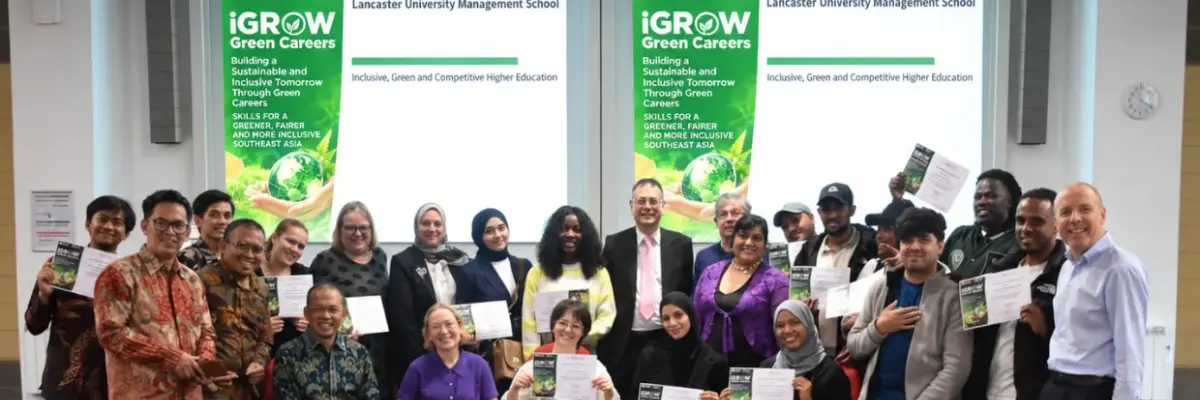
Signatory Spotlight: Lancaster University Management School
 New York, United States
14 Regions Reunite for PRME’s 7th Annual Global Chapter Forum
 New York, United States
PRME at UNGA81: Connecting Business Education, Finance and Leadership for Systems Change