Access

- Submit your institution’s Sharing Information on Progress (SIP) Report
- Access SIP reporting across institutions

Access
Access

 New York, United States
Share


The 81st session of the United Nations General Assembly brought leaders from across sectors and around the world together in New York to discuss global challenges and advance collective action. Under the theme “Restoring trust, managing transformation: A United Nations that delivers for all,” the week provided a platform for conversations on sustainable development, climate action, education, finance and the future of multilateral cooperation.
As part of the week’s programming, the Principles for Responsible Management Education (PRME) community contributed perspectives from students and educators at business schools across a range of engagements.
Bringing the student perspective to the conversation
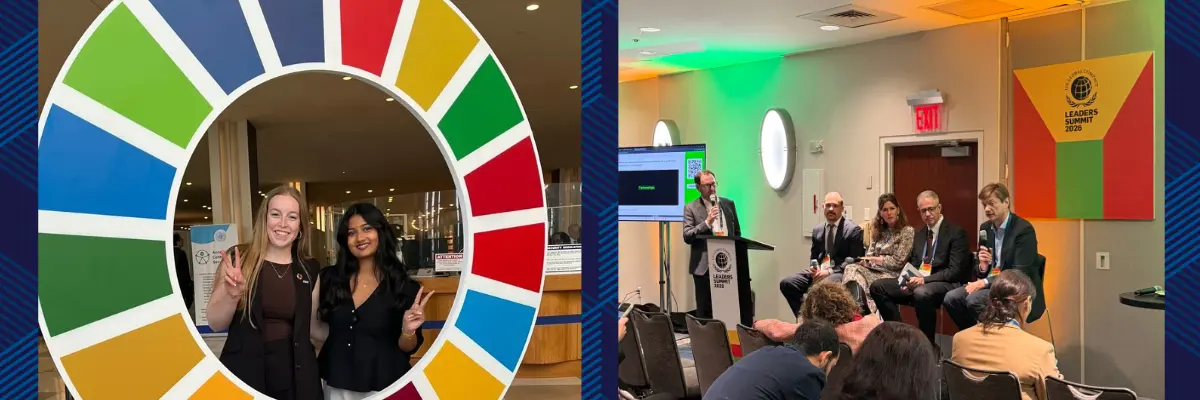
PRME Students Regional Leaders for North America, Lakshita Ganesh Kumar and Ashley Reppert, took part in UNGA81 programming, bringing student perspectives into discussions on leadership, finance and global challenges.
For our Regional Leaders, the week offered an opportunity to learn from leaders across different sectors and regions while gaining a deeper understanding of how global challenges are connected to business, education, and leadership.
Beginning the week at Unstoppable Africa, hosted by UN Global Compact’s Global Africa Business Initiative (GABI), they learned about Africa’s role in shaping the future of business and global development. Across the week, conversations on education, human capital, women’s empowerment, and finance broadened their understanding of different systems that shape opportunities for people and organizations.
At the UN Global Compact Leaders Summit, Lakshita brought these perspectives into her own keynote speech on capital and markets. Drawing on her experience studying computer science and statistics at the University of Connecticut, with a business minor, she highlighted the connection between technical innovation and the financial and market knowledge that help innovations reach scale. “Speaking at the Leaders Summit during UNGA meant being trusted to add to a conversation about the future, not just observe it,” she shared.
Ashley also reflected on the importance of youth voices in global conversations, particularly on issues such as AI, sustainability, and education. Her biggest takeaway was that students can contribute to meaningful change, even when global challenges feel overwhelming. “Our impact actually matters,” she shared, noting that she plans to bring what she learned at UNGA back to her university and other students through conversations and presentations.
The week reinforced for the Regional Leaders the value of learning from, and contributing to, global conversations. Reflecting on hearing from world leaders and influential speakers, such as Malala Yousafzai, who spoke about global education, they were reminded of the influence that individuals can have in advancing issues they care about. Participating in UNGA81 was an opportunity to expand perspectives, build confidence as young leaders, and consider how they can use their own education to create opportunities for students who come after them.
Across UNGA81 and Climate Week, conversations explored how finance and markets can become strong levers for systems change. Dr. G. Andrew Karolyi, PRME Advisory Board Chair, participated in sessions exploring how financial decision-making and organizational practices can contribute to systems transformation.
Drawing on research showing a gap between finance leaders’ recognition of the need to transform financial decision-making and their ability to do so, conversations emphasized the importance of taking action within organizations and across networks. One recurring takeaway was the importance of consistent, high-quality data. Investors need greater consistency in both data and the assumptions underpinning it to make meaningful comparisons and decisions. As AI creates new opportunities to support data collection and comparison, the need for reliable and high-quality underlying data remains critical. At the same time, increasing sustainability-related regulation is bringing finance teams more directly into sustainability reporting and decision-making.
PRME also participated in the One Global Compact Forum, which brought together United Nations Global Compact Country Network Executive Directors from around the world to connect with HQ staff.
The Forum focused on strengthening connections between global strategy, regional expertise and local innovation, reflecting the Global Compact’s work across more than 160 countries. From these discussions, it was evident that PRME needs to be socialized across the One Global Compact network to allow for stronger collaborations in regions where academia is less connected to business. Antonio Hautle, Executive Director of Country Network Switzerland, provided key examples of academic collaboration successes where PRME Signatory Members worked with Swiss UN Global Compact participants on research and training, specifically through the SDG Innovation Accelerator for Young Professionals.
For PRME, engagement with the wider Global Compact community provides opportunities to connect the work of business and management schools with the broader responsible business agenda and to explore how education, research and collaboration can support responsible leadership.
PRME Signatory Members were also represented in sessions throughout the week. Aleksej Heinze of KEDGE Business School, a PRME Signatory institution, participated as a speaker in a session on “Leadership & Integrity,” which explored how collective action, standards, platforms and market-based incentives can strengthen business integrity and create conditions for responsible business to scale.
The session examined the role of collaboration among companies, governments and other stakeholders in addressing shared risks, strengthening market conditions and building trust and resilience across sectors and markets.
PRME also joined SHRM’s Education-to-Employment (E2) Global Roundtable, which brought together employers, educators, workforce leaders, policymakers and international organizations to discuss how to strengthen pathways from education to meaningful employment. The conversation explored how cross-sector collaboration can better connect education and workforce systems, particularly as AI transforms the skills and capabilities needed in the workplace.
Discussions highlighted the importance of combining evolving technical capabilities with human skills such as communication, collaboration, critical thinking and problem-solving, while expanding opportunities for work-based learning, including internships and apprenticeships.
Across these engagements, a common theme emerged: systems change requires more than individual commitments. It requires people with the knowledge, skills and networks to understand how different parts of a system interact, and the ability to act on that understanding.
For the PRME community, this means ensuring that business and management education continues to evolve alongside the challenges facing organizations and society. It means preparing students to understand finance and markets, supporting educators in bringing sustainability into their teaching, and creating opportunities for business schools to contribute research and expertise to global conversations.
Share
New York, United States
14 Regions Reunite for PRME’s 7th Annual Global Chapter Forum
 New York, United States
PRME at UNGA81: Connecting Business Education, Finance and Leadership for Systems Change
Ontario, Canada
Signatory Spotlight: Yorkville University, Canada