Access

- Submit your institution’s Sharing Information on Progress (SIP) Report
- Access SIP reporting across institutions

Access
Access

History
The Working Group builds upon the success of the regional Careers and Sustainability Working Group, established in 2023 under the PRME Chapter UK and Ireland to aid the growing interest in the intersection of work on sustainability, careers, employability and the rapidly evolving green jobs sector. This UK and Ireland group has seen momentum build across events and research projects and currently has nearly 200 mailing list members. The Working Group also builds on the research, teaching and community engagement interests of its founding members in India and the UK. Recognising the global relevance of purposeful careers and the evolving needs of values-oriented workplaces, founding members came together to expand this initiative into a global PRME Working Group.
Purpose
The Working Group addresses the critical intersection between organisational values and employee aspirations. Organisations increasingly emphasise fairness, ethical behaviour, sustainability, stakeholder accountability, and social and environmental impact. Simultaneously, employees—especially Generation Z—prioritise socially and environmentally purposeful work and employers who genuinely commit to equity, diversity, and inclusion. The central challenge is understanding evolving workplace needs and creating recognisable pathways toward purposeful, ethical, and responsible careers for university graduates. The Working Group welcomes diverse participation from employers, students, academics from multiple disciplines, and university professional services teams, all united by shared interests in graduate career ambitions and critical engagement with employer priorities practices for attracting and retaining a values-oriented workforce.
Goals
The PRME Working Group on Responsible Work and Purposeful Careers aims to build an impactful community that advances responsible workplaces and career development globally.
The following goals outline the group's strategic focus:
Knowledge Exchange and Dialogue: Host regular webinars and events to showcase innovative projects and facilitate meaningful dialogue on responsible workplaces and purposeful careers.
Collaborative Research and Tangible Outputs: Instigate collaborative research and pedagogical projects that produce tangible outputs, including publishable research papers, teaching resources, book chapters, case studies, reflective exercises on Ethics, Responsibility and Sustainability (ERS), cross-cultural immersion/outreach programs and student publications
Capacity Building and Training: Provide diversity, equity, inclusion and belonging (DEIB) sensitization, career coaching, connections with social impact groups, and mentoring with talent management teams from corporates to equip the community with the skills necessary for a green workforce transformation.
Sustainable Ecosystem Development: Support students, educators, employers, and careers professionals in promoting responsible workplaces and purposeful, ethical careers aligned with the Sustainable Development Goals.
Strategic Mission-Driven Partnerships: Foster active collaborations to drive the mission forward and generate adaptable resources for green skills acquisition, including UN Global Compact Network Chapters and Students Organizing for Sustainability International.
Please visit the Working Group’s website and LinkedIn for more information about the group and their forthcoming activities.
Research
The Working Group seeks to pursue multi-institutional collaborative research projects to advance responsible workplaces and purposeful careers. Our flagship initiative, the Sustainability in Early Careers research project, began in the UK and Ireland and is expanding internationally with interest from PRME Chapters in North America, DACH, ASEAN, and India. This project uses a shared survey instrument to generate comparative insights across regions. Wider research themes include the sustainability skills gap, green workforce transformation, career development through SDG-oriented storytelling, and enterprise education for responsible business practice.
Members pursue publication in peer-reviewed journals, contribute to edited volumes, and develop practitioner-focused reports. The group emphasises both theoretical contributions and practical applications, bridging academic rigour with real-world impact. The Working Group actively encourages proposals for new collaborative research initiatives that can engage multiple institutions and produce meaningful outcomes for students, educators, and employers. The Working Group also seeks to create virtual conferences/symposia to bridge the gap between academia and industry, as well as joint white papers with industry groups, patents/sustainable careers index.
Engagement Opportunities
The Working Group offers diverse engagement opportunities designed to connect, involve, and expand our global network. This includes hosting regular webinars—planning two within the first six months—featuring member projects, panel discussions on shared interests, and insights from industry practitioners, academics, and educational organisations. These sessions provide platforms for showcasing innovative work and facilitating dialogue among educators, students, career professionals, and employers.
Members will be able to join our mailing list for updates and connect through our planned LinkedIn group for ongoing discussions. We actively recruit organising committee members who contribute by organising webinars or events, ensuring broad participation in leadership. The group facilitates networking among people working on local projects while enabling international collaboration. Members gain access to event recordings, resources, and opportunities to participate in or lead collaborative research and pedagogic initiatives. We particularly welcome contributions from multiple disciplinary backgrounds and encourage partnerships between academic institutions and industry.
The potential for immersion cross cultural program during summer/winter breaks will also be explored.
Resource Development
The Working Group is committed to creating high-quality resources to support the implementation of values-oriented leadership, purposeful careers and responsible management education. Our existing resources span research reports, academic publications, teaching materials, and practical toolkits. The Sustainability in Early Careers report provides empirical insights for educators and employers. The Working Group aims to develop teaching resources, including employability masterclasses, sustainability-focused career development modules, and storytelling approaches aligned with the SDGs. A ‘Green Skills for Green Jobs initiative’, a further collaboration between 5 PRME members in the UK together with Students Organising for Sustainability UK, will generate resources for green skills acquisition in higher education, adaptable to other localities in due course. Resources are designed to be practical, evidence-based, and accessible to diverse audiences, including faculty, careers services teams, students, and employers. All resources seek to emphasise actionable insights that bridge theory and practice in purposeful career development.
To contact all members of the Steering Committee, please email:
info@unprmeworkandcareers.org
Co-Chairs
Dr Jonathan Louw, Oxford Brookes University, PRME UK and Ireland
Dr Karen Cripps, Oxford Brookes University, PRME UK and Ireland
Dr Musarrat Shaheen, Institute of Management Technology (Hyderabad), PRME India
Steering Committee
Dr Ananya Bhattacharya, Monash University, PRME Chapter Australia & New Zealand
Nikhil Reddy Gogu, Antwerp Management School, PRME Chapter France & Benelux (Student and Early Careers Engagement Lead)
Dr Stephen T Homer, Sunway University, PRME Chapter SAEAN
Dr Wulf-Peter Schmidt, CBS University of Applied Sciences, PRME Chapter DACH
Please fill out the form here to join the Working Group.
Please contact info@unprmeworkandcareers.org with questions about this Working Group or to join if you are unable to fill out the membership form. Please contact info@unprme.org with general Working Group queries.
You may join the PRME UKI Careers and Sustainability Working Group LinkedIn Group (which will merge into the global Working Group)

Sustainability in Early Careers Report (2025)
Collaborative research report examining how early-career professionals prioritise and navigate sustainability in their career choices. Developed by Oxford Brookes University, UN Global Compact Network UK, and Windo, with 10 UK and Ireland signatory partners, this resource provides empirical insights for educators and employers on attracting and supporting values-oriented graduates. The report offers practical recommendations for bridging the sustainability gap in placements and internships.
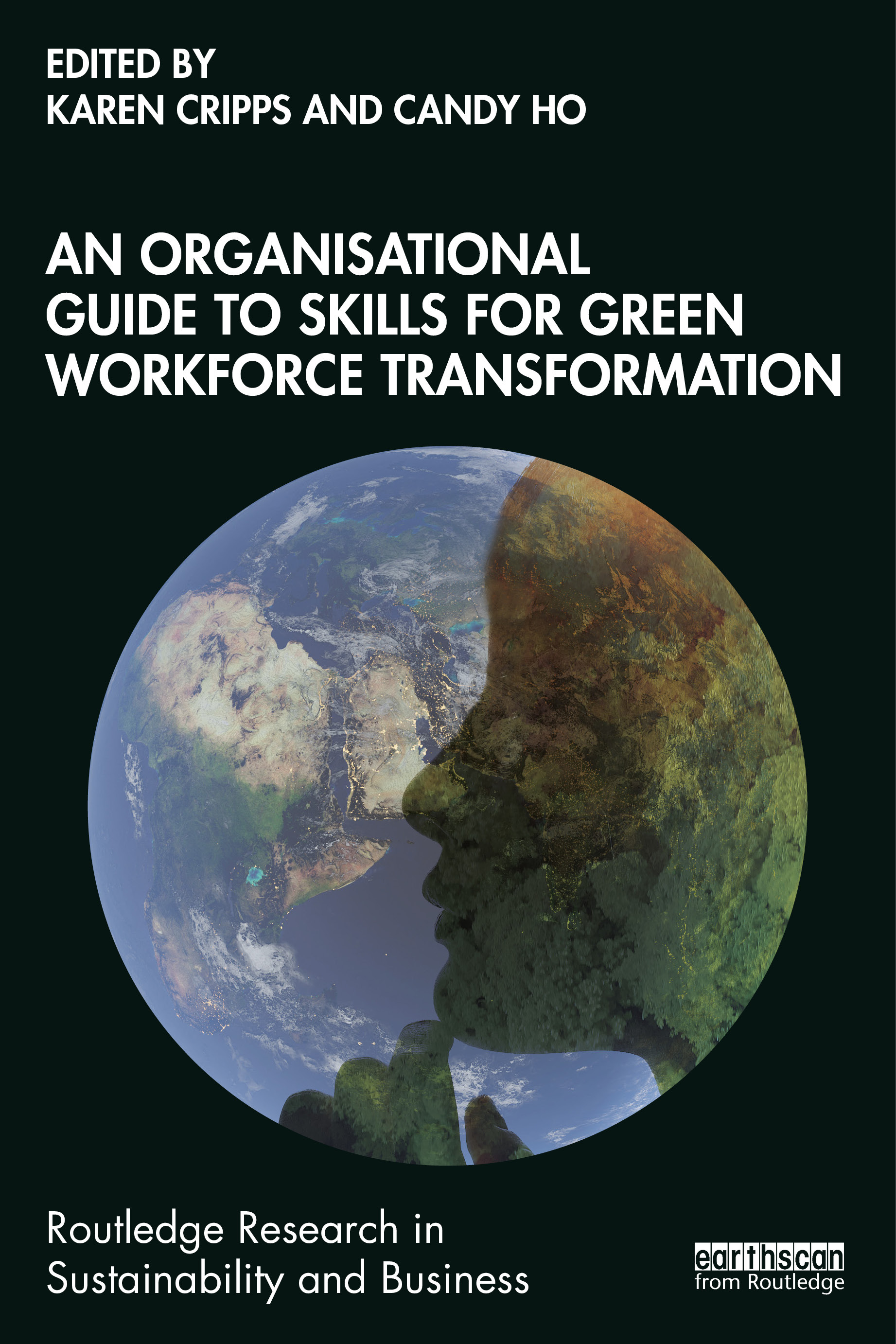
Launching An Organisational Guide to Skills for Green Workforce Transformation (September 2026)
The book launch of ‘An Organisational Guide to Skills for Green Workforce Transformation’ (edited by Karen Cripps and Candy Ho) was a lively webinar hosted by the PRME ‘Working Group on Responsible Work and Purposeful Careers’, in collaboration with the Working Group on ‘Climate Change and Environment’. With around 230 registrations and 100 people joining live, the turnout shows how timely the book is.
The book has 22 chapters and 45 authors from 15 countries and 17 organisations, ranging from community enterprises to multinationals and professional associations. It is written by practitioners, so each chapter gives a first-hand account of the skills a green, just and inclusive transition needs. It is organised around Project Drawdown's leverage points for organisational climate action, and it uses the language of transferable skills (collaboration, communication, adaptability) and transformative skills (the ones that change systems, such as reflexivity and valuing traditional and Indigenous knowledge). The webinar provided the opportunity to welcome students, educators, career practitioners and business practitioners to hear these themes in the authors' own voices.
Why every job matters
Martin Baxter, Deputy CEO of the Institute of Sustainability and Environmental Professionals, welcomed participants and later moderated the discussion. He recalled giving evidence to a parliamentary inquiry in 2010 that the focus should be on making all jobs greener rather than on creating a separate category of "green jobs".
The foreword authors provided a keynote. Drew Wilkinson, founder of Climate Leadership Collective, told how he and a colleague persuaded Microsoft to audit its waste, then kept pushing for six months until the company opened its first zero-waste cafeteria. That grew into an employee sustainability community of more than 10,000 people. His conclusion was that "the climate transition cannot be delivered by sustainability teams alone". Full-time sustainability professionals are often less than 1% of a workforce. He also named the skill he thinks the book should add: courage, because we need people "willing to openly challenge the status quo at work".
Aiyana Bodi of Project Drawdown showed how far a company's climate impact reaches beyond its buildings and products, into its marketing, finance, politics and culture. Each of those areas needs people with the right skills. "We really can't view sustainability as a side project anymore," she said. "We really need it built into organisational capacities."
Eight lightning talks
Each author had three minutes. Georgina Erifeta, writing from Nigeria, argued that environmental knowledge only changes anything "when people have the skills to apply it in their daily work". She advised identifying who drives emissions, training everyone to solve workplace problems with real operational data, and linking actions to emissions targets.
Gemma Butler of ‘Can Marketing Save the Planet’ made the case for marketers and communicators. Sustainability needs storytelling, listening and inclusive communication, because change "happens when people understand the purpose, feel connected to it, and can see how they can personally contribute". Her practical advice was to drop the jargon and move from broadcasting to dialogue.
Kate McGeoch, from Scottish Power, said climate action often happens "in the interstitial tissue of a supply chain", between functions and partners. Her advice was to go to stakeholders with problems rather than solutions, and to value progress along the way.
Megan Simpson of Shared Planet widened the lens from carbon to nature. She argued for breaking down the silos between sustainability and finance, valuing Indigenous knowledge, and looking at where an organisation keeps its money, including its pension and investment options.
Arpit Sharma, from the Skill Council for Green Jobs in India, described transformative skills as those that "help individuals understand a bigger picture, challenge existing ways of thinking, and help to create a better future". He recommended embedding these skills in job roles and recruitment, and in performance reviews.
Deborah McNamara of ClimateVoice argued that influence is itself a transformative green skill. She called for formal support for employee green teams, investment in influencing skills, and a culture where people can speak up without fear of retaliation.
David Jones of the Chartered Management Institute pointed to the "say-do gap". Nearly three-quarters of managers say their organisation prioritises net zero, yet a third are not confident it is ready to change. He noted that 82% of UK managers step into the role with no formal training. "Closing that say-do gap isn't about more ambition," he said. "It's about capability."
Binbin Wang of the Climate Future Global Innovation Lab in China closed the lightning talks. She said, "Long-term thinking is not about predicting the future, it's about building bridges to it." She urged leaders to draw on ancient wisdom, since "we talk about AI, and we forgot that we have another kind of AI: ancient intelligence".
The discussion
Martin chaired the open discussion, which covered hope, engaging SMEs, ethical leadership and equality of opportunity. Candy described hope and action feeding each other "in an upward spiral", and Gemma Butler added that "talking about it also drives hope, and hope drives action". Drew read from the foreword he wrote with Aiyana: "‘Every job is a climate job’ is aspirational because it is incomplete… We need to examine the intersection of sustainability with every job and invite everybody to contribute in the ways they are uniquely and professionally best suited." Martin closed by noting how the collaboration, leadership, communication and influence that run through every chapter give him "a huge amount of hope".
We are grateful to every author who gave their time on top of a day job. Our only regret is that we could not feature more authors or have a longer discussion.
Resources
See the slides: link here
Order the book from Routledge using discount code 26AFLY4 (20% off): https://www.routledge.com/An-Organisational-Guide-to-Skills-for-Green-Workforce-Transformation/Cripps-Ho/p/book/9781041090120
Ask your course leader, library or workplace to buy a copy, to help the book reach as many readers as possible.
If the book is useful in your teaching, practice or organisation, get in touch to share thinking on next steps.
Dr Karen Cripps, Oxford Brookes University Business School (kcripps@brookes.ac.uk)
***********************************************************************************************************
It Creates a Mindset: Why Awareness Alone Won't Build Responsible Careers - July 2026
ANZAM Sustainability and Responsible Management Special Interest Group (SRM-SIG) online seminar
Presenters: Ananya Bhattacharya, Limin Fu, Glen Croy, Wee Chan Au, Tracy Scurry, and Qudsia Iftikhar (Monash University and Newcastle University)
What actually happens to a graduate's sense of responsibility once they leave the lecture theatre? That question sits at the heart of new research presented by Ananya Bhattacharya, Limin Fu, Glen Croy, Wee Chan Au, Tracy Scurry, and Qudsia Iftikhar (Monash University and Newcastle University), funded by Monash Business School's Business Education Research Group.
Drawing on Tams and Marshall's (2011) definition of responsible careers - work through which people seek impact on societal challenges like sustainability and social justice, via their role choices and strategic approach to work - the team surveyed 48 and interviewed 13 early-career professionals across Australia, the UK, and beyond, most within a few years of graduation.
The findings are genuinely double-edged. First, participants consistently described responsibility as an ongoing, negotiated, subjective process - not a fixed checklist. Second, and encouragingly, higher education emerged as a truly formative context: graduates credited their degrees with giving them the language and frameworks - through curriculum and experiential learning - to even think about responsibility at work. As one participant put it, memorably, "it creates a mindset."
But the third finding is the sobering one. Having the mindset is not the same as being able to act on it. Participants described four recurring barriers: structural constraints (junior staff have little strategic influence), economic constraints (mission-driven roles often pay less, forcing compromise), cultural pressures (performance metrics still trump ethical purpose), and - perhaps most damaging - symbolic commitment frustration, where organisations commit for ethical practices at the surface level without real investment or support for the staff, leaving graduates disillusioned.
This matters directly for our Working Group's mission. The researchers argue that PRME-aligned institutions have largely succeeded at building awareness and knowledge, but this now needs pairing with genuine efficacy: confidence, capability, experience, and resilience to act on values under real organisational constraint. The proposed vehicle is authentic learning genuinely engaged with live societal challenges, not simulated exercises.
The provocation for all of us designing responsible management curricula is blunt: are we preparing graduates merely to aspire to responsible work, or to navigate and contest the friction they will actually meet? Closing the gap from mindset to efficacy looks like the next frontier for PRME-aligned business education - and a rich agenda for this Working Group to take forward.
***********************************************************************************************************
Brewing Change: Leadership Dialogue on Women & Careers - March 2026
The event opened with remarks from Prof. Dr. K. M. Baharul Islam, Director IMT Hyderabad, who underscored the importance of addressing three interconnected categories of barriers that women face in the workplace: structural, cultural, and psychological. The discussion framework was introduced by Prof. Dr. Shaheen Musarrat. She presented a three-phase developmental model that outlines how challenges evolve over the course of a woman’s career. According to this model, the first phase—typically early career—centres on idealistic achievement, the second phase, described as pragmatic endurance, usually unfolds during mid-career when professional responsibilities intersect with increasing domestic and caregiving demands, and the third phase of the model, termed reinventive contribution, typically emerges later in women’s careers when they seek to leverage their experience toward broader impact. The dialogue was moderated by Abhijit Bhattacharya, Director – Global Coaching at S&P Global. The session concluded with closing remarks by Prof. Dr. Romina Matthew, Professor of HRM at IMT Hyderabad. The event concluded with a vote of thanks delivered by Kiran Aidhi, CEO of Zunavish Consulting.
An organisational guide to skills for green workforce transformation
Readers of this book will gain practical insights into addressing green transition challenges related to climate, decarbonisation, biodiversity, and social equity through strategic skills development.
The green transition requires more than technical specialists—it demands that every employee, in every role, contributes to organisational transformation. This means developing a broader skill set across the entire workforce and leveraging transferable skills alongside technical competence. Written by organisational leaders for organisational leaders, this book offers evidence-based insights and practical recommendations for developing the skills needed to deliver a "green and just" transition. Contributors from global employers, professional associations, and industry thought leaders share firsthand expertise across diverse sectors in both the Global North and South.
This book is essential reading for learning and development professionals and sustainability leaders and provides clear calls to action for workforce development. It will also prove valuable for educators, career practitioners, and policymakers seeking to understand which skills employers value and how to enable green workforce transformation.
Sustainable Careers Research and Resources of Antwerp Management School
Holding Back Climate Progress: Sustainability's Critical Skills Gap (2024)
Report examining the critical skills gap hindering climate progress, produced in collaboration with Climate Change Coaches. Identifies key competency gaps in sustainability and provides frameworks for addressing workforce development needs in the green economy.
Cripps, K. and Climate Change Coaches (2024) Holding back climate progress: sustainability’s critical skills gap. https://climatechangecoaches.c...
Career and Employability Learning Through Storytelling for the SDGs
Academic article published in the International Journal of Management Education exploring innovative pedagogical approaches using storytelling to enhance career development learning aligned with the Sustainable Development Goals. Provides practical teaching methods for responsible management education.
Cripps, K. and Bobeva, M. (2025) ‘Career and employability learning through storytelling for the Sustainable Development Goals’. International Journal of Management Education. 23 (3)https://doi.org/10.1016/j.ijme...
PRME UK & Ireland Working Group Webpage
Legacy webpage from the founding UK and Ireland Careers and Sustainability Working Group, featuring recordings from past events, resources, and information on previous initiatives that inform the global Working Group's approach.
PRME UK & Ireland YouTube Channel
Video recordings of webinars and events covering topics in sustainability careers, purposeful work, and responsible management education. Features practitioners, academics, and students discussing innovative approaches to career development.
Linking academic engagement and students PsyCap: the mediated role of perceived career adaptability and positive effect.
Academic article published in the International Journal of Work Organisation and Emotion exploring the factors that determine the career adaptability of students.
Shaheen, M., Subramani, A. K., & Jan, N. A. (2024). Linking academic engagement and students PsyCap: the mediated role of perceived career adaptability and positive effect. International Journal of Work Organisation and Emotion, 15(3), 222-242.
Exploring adjustment mechanisms of adolescent expat kids from South Asia against sociopolitical stigma
Academic article published in the Journal of Global Mobility: The Home of Expatriate Management Research which explored the factors behind the adjustment mechanism of adolescent kids of expats from South Asia.
Banerjee, P., Gupta, R., Shaheen, M., David, R., Chenji, K., & Priyadarshini, C. (2020). Exploring adjustment mechanisms of adolescent expat kids from South Asia against sociopolitical stigma. Journal of Global Mobility: The Home of Expatriate Management Research, 8(3/4), 273-290.
A competency framework for contractual workers of manufacturing sector
Academic article published in the Industrial and Commercial Training Journal which explored the competencies of for contractual workers in a manufacturing sector.
Shaheen, M., Azam, M. S., Soma, M. K., & Kumar, T. J. M. (2019). A competency framework for contractual workers of manufacturing sector. Industrial and commercial training, 51(3), 152-164.
Exploring Dimensions of Teachers’ OCB from Stakeholder’s Perspective: A Study in India
Academic Article that identifies dimensions of teacher’s extra-role behavior in India.
Shaheen, M. (2016). Exploring Dimensions of Teachers’ OCB from Stakeholder’s Perspective: A Study in India. The Qualitative Report, 21(6), 1095-1117.
Behavioral Intentions of Academicians Towards Teaching and Research: A Study in the Indian B-School Context
Academic Article that explores the behavioral intention of Indian B-school academicians towards teaching and research.
Shaheen, M., Gupta, M., Sayeed, O. B., & Alok, S. (2014). Behavioral Intentions of Academicians Towards Teaching and Research: A Study in the Indian B-School Context. IUP Journal of Soft Skills, 8(3), 7.
27 October 2026 04:00 AM - 05:00 AM
PRME Working Group on Responsible Work and Purposeful Careers
From Classroom to Purpose: Social Business Education for Responsible Work and Purposeful Careers
How can social business education help students create meaningful, responsible careers?...
17 November 2026 04:00 AM - 17 November 2026 05:30 AM
PRME Working Group on Responsible Work and Purposeful Careers
Open Masterclass: How to Take Part in Erasmus for Young Entrepreneurs
Location: Online
Three Intermediary Organisations of Erasmus for Young Entrepreneurs, the EU exchange programme for new entrepreneurs, explain who can apply and how. Online, Tuesday 17 November 2026, 10:00 to 11:30 a.m. CET....
10 December 2026 04:00 AM - 10 December 2026 05:00 AM
PRME Working Group on Responsible Work and Purposeful Careers
Futures Literacy in times of AI and Sustainability
Location: Online
Discussion on Futures Literacy in responsible business education in times of AI changing work opportunities and Sustainability backlash...