Access

- Submit your institution’s Sharing Information on Progress (SIP) Report
- Access SIP reporting across institutions

Access
Access

 New York, United States
Share


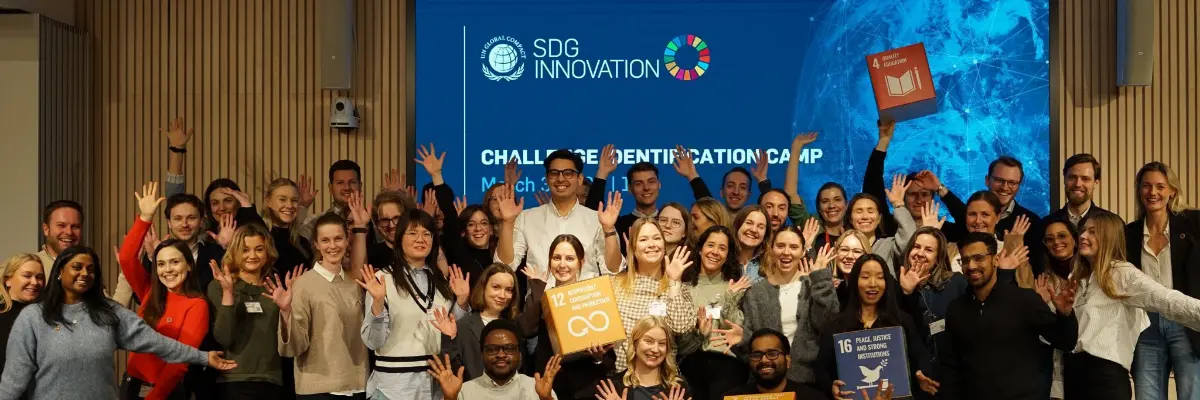
The SDG Innovation Accelerator for Young Professionals continues to translate sustainability ambition into measurable business impact, empowering the next generation of leaders to design solutions aligned with the Sustainable Development Goals (SDGs). In collaboration with the Principles for Responsible Management Education (PRME), the programme is strengthening the connection between responsible management education and real-world business practice.
At the center of the collaboration are the Global Deep Dive Sessions — live, virtual sessions covering systems thinking, sustainable business models, AI for sustainability, change management, and storytelling for impact. Each one gives participants practical frameworks for tackling sustainability challenges inside their own organizations.
Between March and June, 2026, nine leaders from PRME Champions—Signatory Members recognized for expertise in sustainability, innovation, and responsible management— designed and delivered these sessions, ensuring each Deep Dive connects theory to the practical challenges participants face in their companies. In total, 395 companies and over 1,200 young innovators participated.
Professor Noemi Sinkovics, Professor of Sustainable and Responsible Business and Associate Dean for Ethics, Responsibility, and Sustainability at Newcastle University Business School, who facilitated the session on Systems Thinking and Problem Framing for SDG Challenges, highlighted the power of creating shared understanding across disciplines, industries, and cultures.
"The young professionals came from different companies, departments, countries, and professional backgrounds," she reflected. "Engineering teams approached challenges differently from colleagues in business functions, yet everyone was trying to solve meaningful sustainability problems. Through systems thinking and storytelling, we were able to create a common language that helped participants communicate across those differences."
One of the most rewarding moments came when participants recognized that innovation is not a linear process. Discussions around evidence gathering and stakeholder engagement revealed that solving sustainability challenges requires continuous learning, iteration (a key characteristic of the Impactful Five (i5) Framework), and collaboration rather than a single prescribed methodology.
Dr. Vivek Kumar Jha, Assistant Professor and Chair of International Affairs & Collaborations at T. A. Pai Management Institute (TAPMI), led the session on Business Model Opportunities in a Changing Sustainability Landscape. For him, the value was in making academic concepts tangible.
"The Global Deep Dive helped bridge the gap between academic expertise and real-life challenges," he shared. "Using case studies allowed participants to see how sustainability concepts translate into practical business decisions."
The discussions quickly evolved beyond theory. Participants challenged assumptions, asking how tools such as the Business Model Canvas could be applied within their own organizations to drive measurable impact. Those conversations became opportunities to demonstrate that responsible management is not simply a conceptual framework, but a practical approach to identifying opportunities, creating value, and leading organizational change.
The ripple effects reached programme delivery itself. Ben Secretario, Interim Executive Director of UN Global Compact Network Philippines, credited the sessions with strengthening the Accelerator's rollout in the Philippines, noting they helped translate global insights into meaningful local conversations on innovation, sustainability, and solutions-driven action.
"The Global Deep Dive Sessions have been a valuable resource in supporting the successful delivery of the SDG Innovation Accelerator Programme in the Philippines. The sessions provided relevant content, practical guidance, and opportunities to learn from innovation experts and educators, helping us translate global insights into meaningful local conversations on innovation, sustainability, and solutions-driven action."
Bruna Elias, Senior Manager, SDG Innovation Accelerator, Global Operations, UN Global Compact, shared, “PRME Champions played a critical role in turning the Accelerator into a truly applied learning experience. They brought rigorous academic thinking into direct conversation with the realities young professionals face inside their companies, helping participants question assumptions, navigate complexity, and translate sustainability ambition into solutions that can create tangible business and SDG impact."
Together, PRME and the SDG Innovation Accelerator are helping develop leaders who not only understand sustainability, but who have the skills, confidence, and collaborative mindset to embed it into business strategy, inspire organizational change, and accelerate progress toward the Sustainable Development Goals.
Thank you to all PRME Champions faculty who participated in the Global Deep Dives:
Noemi Sinkovics, Newcastle University Business School, UK
Tam Nguyen, District3 at Concordia University, Canada
Vivek Jha, T A Pai Management Institute (TAPMI) at Manipal, India
Zsuzsanna Gyori, Budapest Business University, Hungary
Shiv Tripathi, Berlin School of Business and Innovation, Germany
Yaxin Ma, Sunway Business School, Malaysia
Fara Azmat, Deakin University, Faculty of Business and Law, Australia
Belen Lopez, ESIC Business & Marketing School, Spain
Ranjit Voola, The University of Sydney Business School, Australia
Share
New York, United States
14 Regions Reunite for PRME’s 7th Annual Global Chapter Forum
 New York, United States
PRME at UNGA81: Connecting Business Education, Finance and Leadership for Systems Change
 Ontario, Canada
Signatory Spotlight: Yorkville University, Canada