Access

- Submit your institution’s Sharing Information on Progress (SIP) Report
- Access SIP reporting across institutions

Access
Access

 New York, United States
Share


Great ideas alone are not enough to solve the world's most pressing challenges. Turning bold ideas into real-world impact requires mentorship, collaboration, practical skills, and the confidence to move from ambition to action.
That belief lies at the heart of the PRME Students Innovation Studio: a global incubator designed to help interdisciplinary student teams transform sustainability-focused ideas into ventures capable of advancing the Sustainable Development Goals (SDGs). Through a six-week programme, 38 student teams from 21 countries - selected from over 100 applications - worked alongside mentors, entrepreneurs, and industry experts to refine their venture ideas and pitches before presenting them on the global stage at the PRME Student Summit, part of Responsible Management Education Week 2026 at the Onsi Sawiris School of Business at the American University in Cairo.
The Innovation Studio was made possible through the support of the Project Management Institute (PMI) and was co-designed with District 3 Innovation at Concordia University and Deakin Business School, bringing together expertise in entrepreneurship, design and systems thinking, and project delivery to help students turn purpose-driven ideas into viable ventures.
The Innovation Studio was designed by the strategic partners to bridge a critical gap between students' aspirations and their ability to put those ideas into practice. "Many students are passionate about creating positive social, environmental, and economic impact. However, there is often a gap between their aspirations and the opportunities available to develop, test, and refine ideas in a supportive environment," said Dr. Ruby Ma Lecturer from Deakin Business School.
The Deakin team saw the programme as an opportunity to cultivate globally minded leaders. "The Innovation Studio created a platform where students could see themselves not simply as learners, but as active contributors to addressing global challenges," Dr. Ma explained. By collaborating across countries and disciplines, students gained firsthand experience working through the kinds of complex sustainability challenges they will encounter throughout their careers.
That vision was shared by District 3 Innovation, "They have the ideas, but not always the vehicle to get those ideas off the ground," said Tam Nguyen, Ideation Stage Lead from District 3. Through exposure to mentors, entrepreneurs, judges, and fellow innovators, students were challenged to test assumptions, refine their thinking, and focus less on becoming attached to a single solution and more on responding to the real needs of the communities they aim to serve.
As Tam noted, the programme's impact extends well beyond venture development. Whether or not a startup ultimately succeeds, the experience gives students "inspiration and confidence to keep moving forward," while showing them they can continue playing an active role in advancing global sustainability.
For PMI, supporting the Innovation Studio reflects a shared commitment with PRME to prepare future leaders who can move beyond ambitious ideas and deliver measurable impact.
The PMI teams’ expertise was embedded throughout the programme. Pascal Godjo and Aurio De la Cruz Salazar, mentored student teams, offering practical guidance on project structuring, stakeholder alignment, and implementation strategies to ensure ventures were not only innovative, but grounded in real-world delivery frameworks. During the semifinal round, Michael Pace, Ph.D., Sustainability Expert at PMI, and Lucila Dotto, Global Head of Sustainability & Enablement at PMI, served as judges, evaluating ventures based on both their innovation and alignment with the Sustainable Development Goals.
At the 2026 PRME Global Forum, Michael further reinforced the importance of execution by joining the panel, PRME Students Innovation Studio: Empowering Youth to Advance the SDGs. Reflecting on what future sustainability leaders need most, he explained: "Developing the next generation of sustainability leaders comes down to three things: knowledge, competency, and agency. If students have the knowledge but cannot apply it, mentorship, certification, and communities of practice build real execution capability."
By combining entrepreneurial thinking with practical project management, the Innovation Studio equipped students not only to imagine solutions to global challenges, but to build the capabilities needed to deliver them.
For participating students, the programme's impact extended far beyond the final pitch competition.
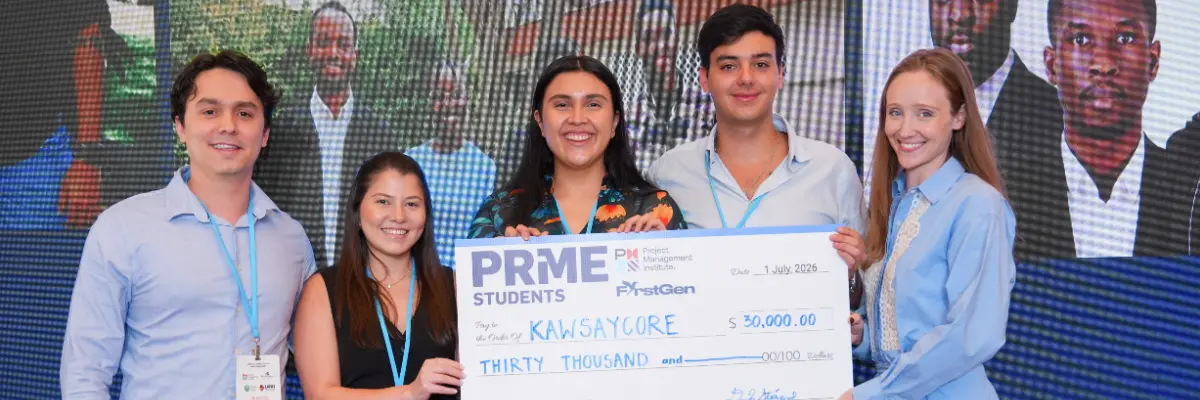
The inaugural Innovation Studio winner, KAWSAYCORE from INCAE Business School, received US$30,000 in seed funding for its biodegradable fertilizer coating designed to improve agricultural sustainability. "Competing at this global level pushed us to grow significantly, both as leaders and as a venture," the team reflected. The programme challenged them to refine their value proposition, validate their approach with an international audience, and strengthen their pitch under the guidance of mentors and an expert jury.
That growth was evident to mentor Dr. Shiv Tripathi, Dean of the Faculty Berlin School of Business and Innovation, and PRME Advisory Board Member, who said the team stood out for its "clarity of concept, focus on the required key areas, and openness to critical assessment followed by improvement action." Rather than providing answers, Shiv guided the team by asking questions that sharpened its focus and relevance. "The team listened, reflected, and responded well," he said.
"The mentorship, the connections made in Cairo, and the exposure to other outstanding student-led ventures from around the world have been just as valuable," the team shared. "They've shown us what's possible when purpose-driven innovation meets rigorous business thinking."
Now, the team is using the seed funding to strengthen its commercial operations in Colombia while expanding trials across additional crops and geographies. They credit the Innovation Studio with preparing them for this next stage of growth, "The pitch coaching sharpened how we present our business model and impact story to investors and partners, and the storytelling and change-management sessions gave us frameworks we're already applying as we grow our team and formalize our operations." The recognition has also accelerated the venture's momentum, with recognition becoming "a key door-opener in outreach to academic institutions and potential partners," leaving the team more prepared, more connected, and more determined to scale their impact.
Runner-up Fainin, a trust-enabled sharing marketplace from the University of Hamburg, found that the Innovation Studio's structured approach strengthened both its venture and its ability to communicate its value. Through milestone-based gate reports, the team was challenged to validate assumptions and define what success would look like for each of its core hypotheses, giving it concrete criteria to evaluate future pilots rather than relying on "a general sense of progress." Mentorship from Koshu Kunii of Lifetime Ventures further sharpened the team's thinking, while the Innovation Studio has become "a useful reference point when we approach sustainability teams at larger companies."
Looking ahead, Fainin is launching paid pilots of its Community Edition with corporate and university partners, completing an ESG dashboard that will enable partners to report avoided Scope 3 emissions for Corporate Sustainability Reporting Directive reporting, and preparing for a seed funding round. "The seed funding goes directly into the pilots and into that reporting layer," the team shared, demonstrating how the programme continues to shape the venture's next stage of growth.
For Cleanvestia from Strathmore University Business School, the experience built confidence alongside technical capability. "I think it has shaped the confidence we have in how we approach opportunities and taking on global stages with ownership of our ideas," the team shared. They credited mentorship from Dr. Swati Nagpal, Senior Lecturer at La Trobe Business School, as well as valuable feedback and networking opportunities throughout the PRME Global Forum—including guidance from Chigozirim Bodart, Chief of Staff at the UN Global Compact—for helping refine their venture. Combined with practical tools such as the Social Business Canvas, these insights have helped move Cleanvestia closer to developing a functional minimum viable product.
New ventures are entering the market, international partnerships are taking shape, and students are leaving with the confidence and capability to transform ambitious ideas into sustainable solutions.
PRME congratulates all of the students, organizations, mentors, judges, and partners who made this year's Innovation Studio a success and looks forward to continuing to support the next generation of responsible leaders driving sustainable change around the world.
KAWSAYCORE
School: INCAE Business School
Student Team:
Raúl Ulate Sancho
Samuel Garzón
Sofía de los Ángeles Marín Rivera
Andrea Garcia
Venture: A biopolymer-based fertilizer coating that improves nutrient efficiency while reducing environmental damage caused by agricultural runoff.
Fainin
School: University of Hamburg
Student Team:
Maximilian Lehmann
Kevin Mattutat
Jan Seeberg
Venture: A trust-enabled sharing marketplace that helps businesses and communities increase product utilization by renting and lending underused items rather than purchasing new ones.
Mifie
School: Newcastle Business School
Student Team:
Armel Konan
Nojood Alaqeel
Ashlene Robinson
Ismael Akoumou
Venture: A micro-investment platform enabling small investors to fund climate-smart farming projects while improving farmers' access to capital.
Healink
School: MCI | The Entrepreneurial School®
Student Team:
Helin Hussein
Matthias Hansen
Jannis Pohl
Benedikt Grosser
Venture: A MedTech startup developing the world's first non-invasive technology to accurately measure glucose levels.
Freshelf
School: Newcastle University
Student Team:
Esraa Mohamed
Omnia Elshorbagy
Shu Li
Muhammad Shafiqul Hoq Akand
Venture: An AI-powered visual inspection tool that identifies potato spoilage early to reduce food waste across supply chains.
Cleanvestia
School: Strathmore University Business School
Student Team:
Lewis Sange
Ian Omwenga
Preston Ndegwa
Hope Wanjohi
Venture: A digital marketplace connecting waste collectors, recyclers, and manufacturers to improve recycling efficiency while creating new income opportunities.
Share
New York, United States
14 Regions Reunite for PRME’s 7th Annual Global Chapter Forum
 New York, United States
PRME at UNGA81: Connecting Business Education, Finance and Leadership for Systems Change
 Ontario, Canada
Signatory Spotlight: Yorkville University, Canada