Access

- Submit your institution’s Sharing Information on Progress (SIP) Report
- Access SIP reporting across institutions

Access
Access

 New York, United States
Share


More than fifteen years ago, Dr. Christian Hauser, current Chair of PRME’s Working Group on Anti-Corruption, first engaged with PRME at a formative moment, both in his academic career and in the evolution of the global sustainability agenda. At the time, the University of Applied Sciences of the Grisons (FHGR) had just become the first PRME Signatory in Switzerland. Simultaneously, the PRME Working Group on Anti-Corruption was launched in support of UN Global Compact’s 10th Principle, on Anti-Corruption, aligning seamlessly with Dr. Hauser’s research on corruption in international business.
“The purpose of the newly formed Working Group aligned with my research interests,” he recalled. “I wanted to take this opportunity to become more involved with like-minded international peers.”
What began as thematic alignment soon evolved into sustained leadership over the years. After nearly a decade of collaborative curriculum development, research, and global engagement within the Working Group, the founding Chair retired and encouraged Dr. Hauser to take on the role. Already a core member of the group’s leadership, the transition felt both natural and meaningful. “When I was asked if I would like to become the next chair, I volunteered gladly,” he said.
Under his leadership, the Working Group has grown into a platform not only for academic collaboration, but for shaping how anti-corruption is understood, researched, and taught within business education worldwide.
Driving a global dialogue on ethics, compliance, and integrity
Serving as Chair significantly expanded Dr. Hauser’s role as both an academic and a sustainability leader. Acting within the framework of a UN-supported initiative created opportunities for deeper collaboration with the UN Global Compact and other organizations, including UNODC, UNDP, UNESCO, and the OECD. “Becoming the chair created momentum for more active engagement with international organizations, in addition to ethics and compliance practitioners from the private sector,” he said. He referred to the overlapping missions that naturally create opportunities for collaboration, such as in research projects, events, and collective action initiatives.
One of the Working Group’s current research initiatives focuses on the Changing Role of the Chief Compliance Officers and is nearing completion. The applied research project brings together 28 academics and practitioners to explore how ethics and compliance leadership must evolve in increasingly complex and uncertain contexts. The project also informs curriculum development at business schools to educate future ethics and compliance leaders, either through stand-alone modules or by integrating the new knowledge into existing courses. This work will culminate on April 15, 2026, with an international event co-organized with the UN Global Compact and local organizations. The event will promote cross-sector dialogue on governance, integrity, and responsibility.
At the heart of this work is a firm conviction that anti-corruption is foundational to sustainable development. “The fight against corruption is a central issue,” Dr. Hauser emphasized. “Many unsustainable business practices are only possible because corruption allows laws and regulations to go unenforced.”
Drawing on examples ranging from illegal logging and habitat destruction to the Rana Plaza tragedy, he emphasized that corruption is not confined to certain regions. “Our recent research project on corruption during the Covid-19 pandemic clearly showed that it is a global issue. We examined cases in both the Global South and Global North,” he noted. Addressing it requires shared responsibility across sectors and geographies. “Only through collective action can this grand challenge be addressed.”
Bringing PRME into the classroom and beyond
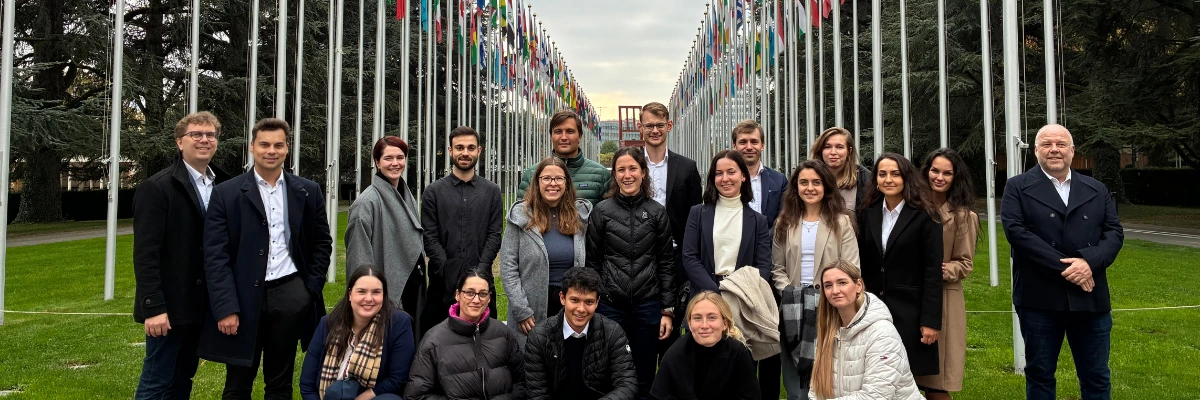
PRME’s influence extends far beyond research outputs; it has also fundamentally shaped how Dr. Hauser approaches teaching and student engagement. He has created immersive learning experiences for students, including a Model United Nations-style SDG-negotiation simulation at the UN in Geneva. He has also engaged with PRME Chapters, particularly Chapter DACH and Chapter Latin America and the Caribbean (LAC), as well as with UN Global Compact networks, to organize the annual European-Latin America Forum. Since 2021, the forum has addressed current issues related to sustainable development and economic relations between Europe and Latin America. The 2026 edition will take place on March 19.
“These experiences are much more enriching for the students thanks to the PRME network,” he reflected. “Without it, it would be much more difficult to organize international activities like these.”
For students, the impact is deeply personal. Exposure to international peers and lived experiences, such as engaging with high-level speakers who grew up affected by child labor, transforms abstract concepts into tangible realities. “Afterwards, one of my students told me, ‘Wow, that was so eye-opening,’” he shared. “Hearing directly from such guest speakers changes how students understand these grand challenges.”
Reflecting on his long-standing engagement with PRME, Dr. Hauser emphasizes that its strength lies in shared ownership, collaboration, and continuity. His advice to institutions seeking deeper engagement is clear: build teams, involve colleagues at all levels, and embed PRME across research, teaching, and leadership.
“It’s not just one person,” he said. “If as many colleagues and students as possible are involved, PRME can really flourish over the years.”
Share
New York, United States
PRME at UNGA81: Connecting Business Education, Finance and Leadership for Systems Change
 Ontario, Canada
Signatory Spotlight: Yorkville University, Canada
 Suntec, Singapore
Reimagining Business Education at One Impact Week 2026 in Singapore