Access

- Submit your institution’s Sharing Information on Progress (SIP) Report
- Access SIP reporting across institutions

Access
Access

PRME Working Groups deepen collaboration in and across PRME Signatory institutions on specific issues relevant to corporate sustainability, responsibility, and the United Nations Sustainable Development Goals. Each Working Group brings together educators, faculty, and researchers to advance responsible management education through shared research, dialogue, and resource development.
Working Groups contribute to the PRME community by developing and publishing resources that raise awareness and strengthen knowledge around responsible management education and other thematic areas in business and sustainability.
Over the years, PRME has strengthened the shared purpose and to support deeper collaboration across the global community. This process was grounded in the belief that the Working Groups are most effective when they bring people together, align around a clear mission, and generate meaningful contributions to responsible management education.
This included clearer leadership pathways, more consistent opportunities for engagement, and processes that reflect PRME’s commitment to equality, diversity, and global representation. These updates were designed to help Working Groups collaborate with greater clarity, share knowledge more effectively, and create outcomes that reflect their collective expertise.
PRME has moved forward with a renewed sense of focus and alignment, ready to continue meaningful collaboration with the Working Groups that remain dedicated to the PRME community, the shared global purpose that guides our work, and the thematic issues that define each group. We offer our sincere thanks to all members who contributed their insight and energy throughout this transition, and especially to the Working Group Chairs whose steady leadership supported their communities and advanced this collective effort. Their commitment has strengthened the foundation of the Working Group community, and we look forward to building on this strengthened structure in the years ahead.
All Working Groups are committed to advancing responsible management education within a particular issue area related to the SDGs, while maintaining unique goals. Explore each group below to learn more about their purpose, objectives, engagement opportunities, and developed resources.


The purpose of the Working Group is to develop and support practices that allow an economic system to work for 100% of humanity (Buckminster Fuller) through life-conducive management approaches.


The Working Group was established to foster interdisciplinary collaboration, build educator capacity and advance responsible supply chain governance in alignment with the Principles of PRME.

The Working Group addresses the critical intersection between organisational values and employee aspirations

The Working Group promotes research, scholarship, pedagogical practice, and knowledge sharing aimed at advancing emerging technologies in alignment with the Principles of PRME and the SDGs.

The Working Group seeks to enable research, teaching, and practices that wisely transform service systems for the well-becoming of humanity and the living planet.

The Working Group explores developing the Sustainability Mindset by building awareness, shifting unsustainable paradigms, developing pedagogical approaches and assessing the impact.
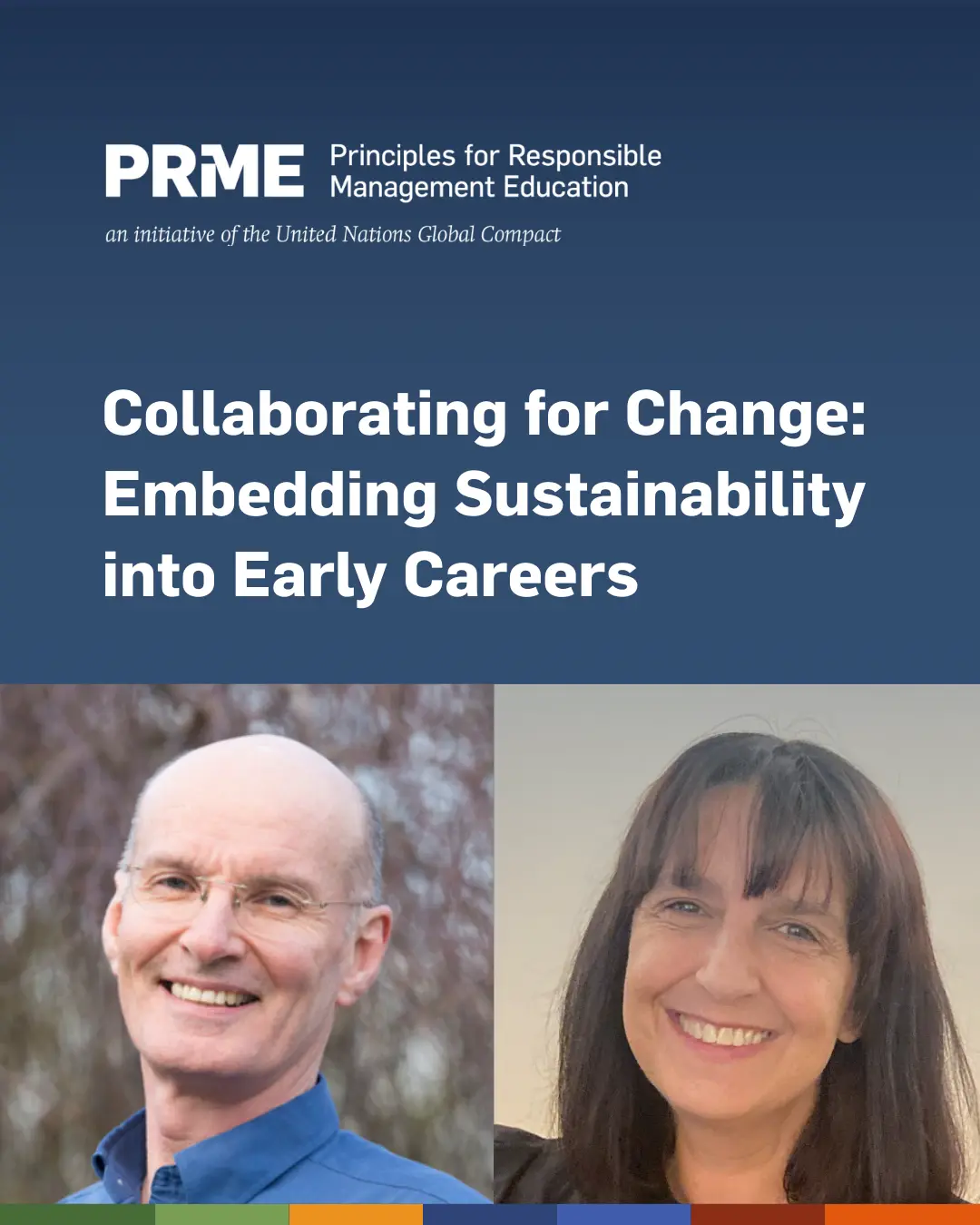
The Sustainability in Early Careers report reveals a growing disconnect between students eager to apply sustainability skills and employers who fail to clearly signal relevant opportunities, despite claiming sustainability is central to their operations. Developed through a collaboration between ten universities, the UN Global Compact Network UK, PRME Chapter UK & Ireland, and student platform Windō, the research offers practical recommendations to better align education, paid placements, and employer engagement—providing a model other PRME Chapters can replicate globally. This work has lead to the PRME Working Group on Responsible Work and Purposeful Careers.
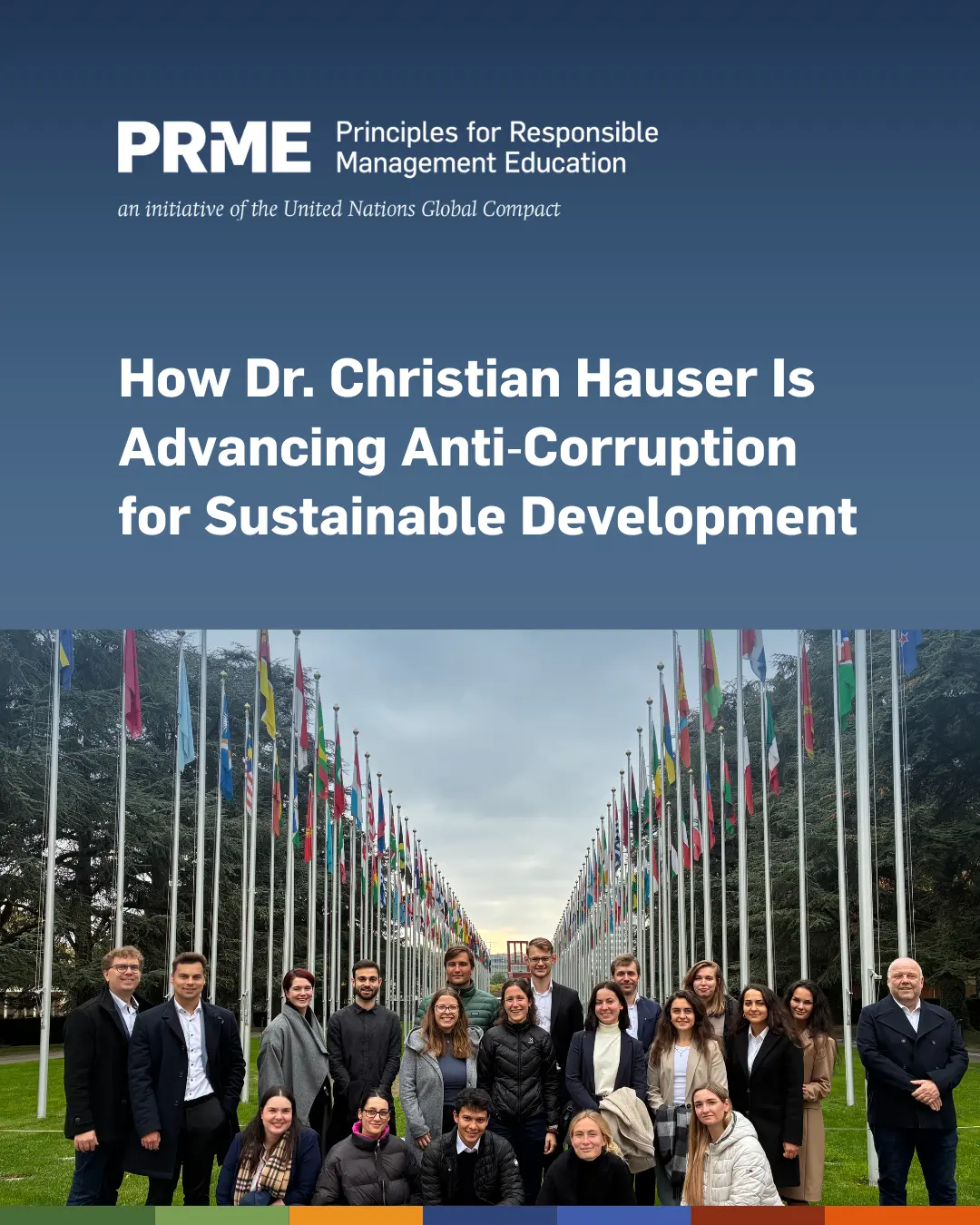
Dr. Christian Hauser first engaged with PRME when his institution became Switzerland’s first Signatory and the Anti-Corruption Working Group was launched, aligning closely with his research; over time, he stepped into leadership and now serves as Chair, advancing global dialogue on ethics, compliance, and integrity in collaboration with the UN Global Compact and other international partners. Under his guidance, the Working Group has become a platform for research, curriculum development, and cross-sector engagement, embedding anti-corruption at the heart of sustainable development and transforming how students and institutions address global governance challenges.
PRME Working Groups bring together faculty, staff, and researchers to advance responsible management education around specific thematic areas aligned with the Sustainable Development Goals (SDGs). We will be accepting Working Group expressions of interests on a rolling basis starting August 2026.
The following steps outline how to express your interest and begin the community building process:
Develop a Proposal
Start by defining a Working Group theme that is distinct from other existing groups and aligned with PRME’s mission, strategic goals, and relevant SDGs. You may consider inspiration from UN Global Compact issue areas or the SDG Action Groups. The focus or theme of the proposed Working Group which would serve as the Group name or title.
Proposed objectives or initial priorities (research outputs, resource development, events, or community-building goals, etc.)
What initial support or commitment (if any) do you have from other PRME Signatories or partners?
Plan of how you intend to engage and grow the Working Group community.
Submit an Expression of Interest
We are looking for submissions which expand the areas of work that the PRME Working Groups presently cover, with priority for new thought leadership groups, greater geographic diversity, and thoughtful, creative contributions that advance quality education, responsible management education, and sustainable development.
Submissions will be reviewed within one month of being received and the designated point of contact (Chair) will hear back via email from the PRME Secretariat.
Note: The PRME Secretariat will review your proposal and make a determination on whether the proposal will be considered for full WG status. A submission does not guarantee the establishment of a Working Group community. Once the Secretariat confirms the status of the submission, you may continue to the future points of establishment.
Approval
Once your submission is approved, the following steps will take place:
Grow Interest and Stakeholder Support: Connect with colleagues, institutions, and relevant experts who share your focus to build a foundational network for your focus area. We encourage leveraging the PRME Common’s Member Directory to identify and connect with potential collaborators.
Define Leadership Structure: To ensure effective coordination, clearly define your leadership structure. Identify at least one Chair (two are ideal) who will serve as the primary liaison with the PRME Secretariat. You must establish a steering committee as the primary governance body. You may structure your steering committee as you see fit (ex. potential steering committee roles), but at least 51% of members must represent PRME Signatories. We encourage you to think broadly and inclusively, identifying colleagues from different regions and institutions so that the group begins with global representation and community engagement at its heart.
Plan Activities and Outputs: Once your leadership and committee are established, it is time to determine your group's operational plan. Clearly outline how meetings will be conducted and how members will collaborate on an ongoing basis. Develop a strategic overview of key activities for the first year, such as webinars, research initiatives, or educational resources.
Sign the Memorandum of Understanding (MoU) and the Steering Committee Code of Conduct (CoC): To move forward as a Working Group, all members of the steering committee and chair(s) must sign the CoC and the Chair(s) must sign the MoU. These resources are designed to guide our shared work with clarity, accountability, and purpose, while ensuring that every Working Group continues to contribute meaningfully to Responsible Management Education (RME) and the Sustainable Development Goals (SDGs).
These documents include:
Clear expectations for how Working Groups operate, govern themselves, and engage with the Secretariat and broader PRME Community.
Clear expectations for how the Secretariat will engage, and support the Working Groups to ensure robust infrastructure and communication channels for content alignment and delivery are provided.
Commitments to inclusivity, transparency, and accountability that ensure our work reflects PRME’s Principles and values.
Provisions for both individual and group responsibilities, including guidance on leadership transitions and the natural lifecycle of Working Groups.
Stay up to date with opportunities to start a new PRME Working Group by subscribing to our opportunity alert.
Deadline: 15 October, 2026
PRME Working Groups are dynamic communities of Signatory Members who deepen collaboration in and across institutions on specific issues relevant to corporate sustainability, responsibility management education, and related to the United Nations Sustainable Development Goals (SDGs). The Secretariat is welcoming expressions of interest from Signatory Members (individuals or groups) who wish to propose a new Working Group in response to emerging issues, gaps, or opportunities aligned with PRME’s mission and the SDGs.
30 September 2026 11:00 AM - 12:30 PM
PRME Working Group on Responsible Work and Purposeful Careers
An organisational guide to skills for green workforce transformation - Book Launch
Location: Online
PRME Global Working Group on Responsible Work and Purposeful Careers event launch of the book 'An organisational guide to skills for green workforce transformation'....
16 January 2027 04:00 AM - 24 January 2027 12:00 PM
PRME Working Group on Arts for Impact
Imagining Tomorrow 2027
Location: In-person
Imagining Tomorrow 2027 16–24 January 2027 | The Eugeniusz Geppert Academy of Art and Design, Wrocław, Poland Imagining Tomorrow 2027 invites students from art, design, business, and applied sciences to work together on real projects with real social, cultural, and organizational relevance....