Access

- Submit your institution’s Sharing Information on Progress (SIP) Report
- Access SIP reporting across institutions

Access
Access

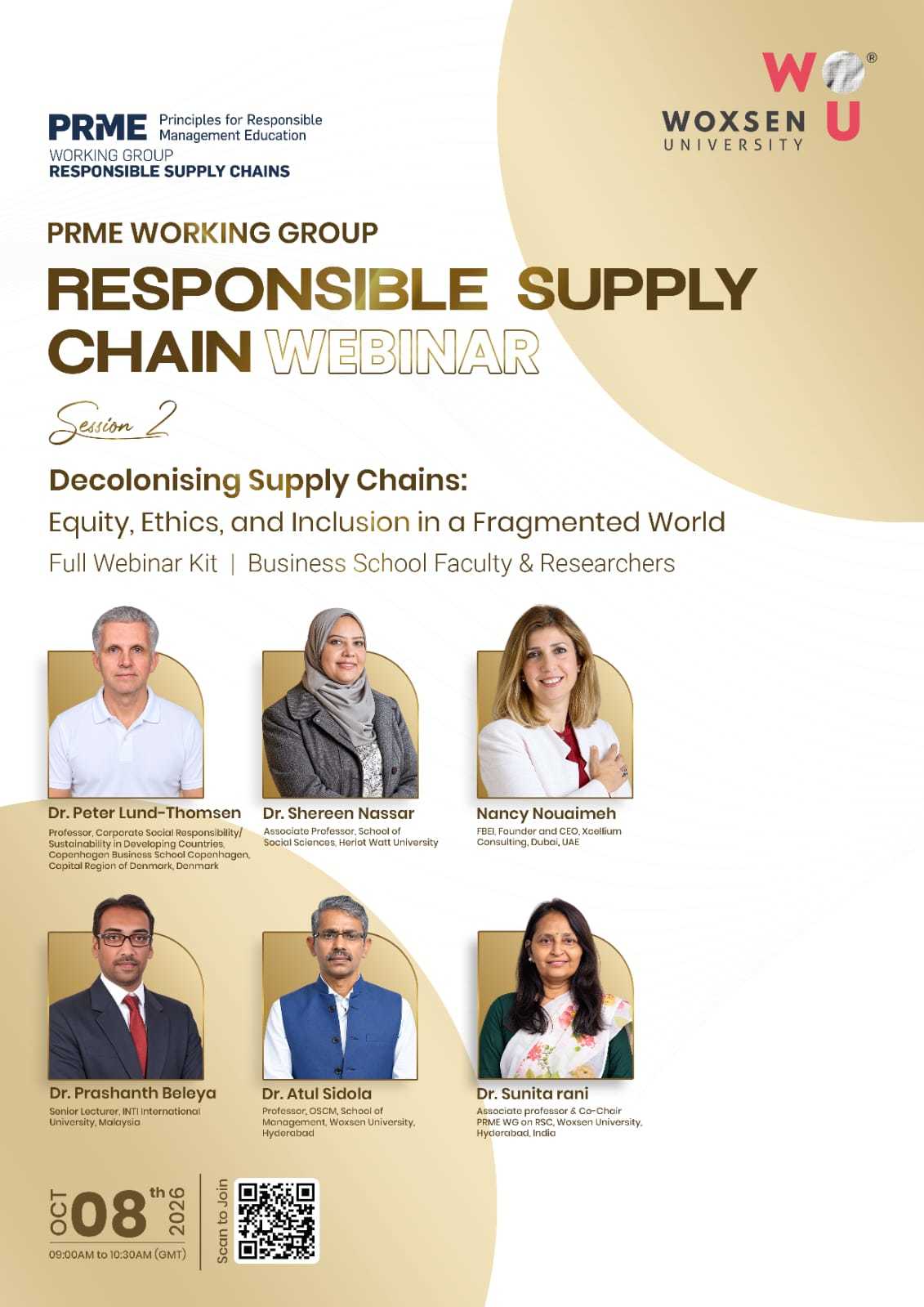
PRME Working Group on Responsible Supply Chains
Overview
Global supply chains have long been shaped by colonial legacies — structures of extraction, dependency, and asymmetric power that persist beneath the language of 'efficiency' and 'comparative advantage.' The disruptions of polycrisis have made these inequities starker: it is workers in the Global South, smallholder farmers, and marginalised communities who bear the heaviest burden when supply chains fracture, yet their voices remain largely absent from boardrooms, procurement decisions, and business school classrooms.
The Decolonisation Imperative
Decolonising supply chains is not simply about sourcing from diverse suppliers or including Global South case studies in a syllabus. It requires interrogating foundational assumptions:
Framing: A Fragmented World
In a world of accelerating geopolitical fragmentation — where friend-shoring, reshoring, and de-globalisation are reshaping trade architecture — there is a real risk that 'resilience' becomes a cover for re-concentrating supply chains in the Global North, leaving the most vulnerable suppliers and workers behind. This webinar asks: can decolonisation and resilience be pursued together? And what is the responsibility of business schools in this moment?
Objectives