Access

- Submit your institution’s Sharing Information on Progress (SIP) Report
- Access SIP reporting across institutions

Access
Access


 New York, United States
Share


When the University of Sydney Business School needed to shift to online teaching during the COVID-19 pandemic, Dr. Dewa Wardak was brought in, not from a traditional business background, but as a learning sciences expert. With a master degree in Learning Sciences and Technology and a PhD in educational design, Dr. Wardak had long focused on how students learn and how to make learning more meaningful. That expertise became a vital bridge between pedagogical theory and practical classroom transformation.
During the COVID-19 pandemic, Dr. Wardak transitioned from the School of Education to the Business School to support the digital transformation of teaching. What began as a temporary assignment quickly evolved into a longer-term mission: helping business educators become more effective, student-centered teachers. She saw a familiar opportunity: faculty were deeply enthusiastic about improving their teaching, and with greater access to resources and support, that energy could be transformed into meaningful innovation.
In 2023, she discovered PRME’s Impactful Five (i5) framework, and it was a turning point. The i5 framework provided the tools, language, and structure she needed to engage her colleagues and students in a more accessible and impactful way.
“It became my way in,” she said. “i5 allowed me to introduce innovation in ways that were relatable and practical, especially for those without a background in learning science.”
Rethinking Leadership in a Post-Crisis World
As part of the Leading in a Post-Crisis World programme, Dr. Wardak coordinates and teaches Managing Post-Crisis Through Action Research, a course designed to move beyond traditional leadership theory and help students lead through uncertainty with confidence, empathy, and curiosity. Students work in teams to identify real-world problems, conduct action research, gather data, and, with ethics approval, have the opportunity to publish their findings.
“So many students think they need a title to lead,” she noted. “We help them understand that leadership is about taking initiative and having agency. It’s in the small choices, every day.”
She integrated the i5 framework into the course to support experiential learning and structured reflection. The approach resonated deeply with students, highlighted by her receiving a faculty teaching award at her institution, and earning 100% satisfaction in student feedback across all six evaluation categories.
“To me, that recognition reflects the power of practical application. Theory is important, but students need to see the relevance in their own lives and careers.”
Museums, Magpies, and Meaningful Fun
To make leadership concepts tangible and enjoyable, Dr. Wardak partnered with the Chau Chak Wing Museum to co-design object-based learning workshops. One session began with an object-based learning exercise: students observed a preserved magpie specimen and were asked, “What does this magpie have to do with leadership?”
To challenge conventional ideas of leadership, the magpie specimen was used to help students move beyond the typical image of men in suits. Students first explored the bird’s dominant traits, like its sharp beak and swooping behaviour, to consider leadership as assertive and commanding. With deeper insight into magpie behaviour, they began to see leadership as collaborative and goal-oriented. The discussion was then expanded to other museum objects from various cultures and eras. Like the magpie, these objects encouraged students to reflect on context, usage, and their own biases. Working individually and in groups, students uncovered diverse perspectives on what it means to lead. The experience sparked reflection on how leadership has looked different across cultures and time periods.
“Our students are often focused on titles like manager, director, or CEO. We wanted them to see that leadership in a different way.”
Through these creative, interdisciplinary approaches, students were encouraged to think critically, collaborate meaningfully, and reimagine what leadership can look like in their own lives and careers.
A Community-Centered Vision for the Future
Dr. Wardak sees a broader shift unfolding in business schools, moving from aspirational slogans to practical, values-driven education. The University of Sydney continues to deepen engagement with PRME with three different staff dedicated to supporting the membership, providing clear entry points for Dr. Wardak to take advantage of the offerings. The PRME team recently launched two new initiatives: an intranet page for educators and a Canvas portal for students.
The educator page introduces PRME and mini case studies to help faculty align teaching and research with sustainability goals. The student portal showcases SDG-aligned courses, student testimonials, and curated resources to make global goals feel accessible and actionable.
“We don’t want responsible leadership to just be a slogan. We want it embedded in how we teach, how we learn, and how we lead.”
Dr. Wardak also mentors students across Australia through the Australasian Council for Undergraduate Research. From helping one mentee navigate a PhD application to connecting another with industry leaders in the music-insurance sector, she emphasizes empowerment through small, strategic steps.
“Mentorship is about helping students recognize their agency, showing them that leadership starts with the courage to ask the right questions and take initiative.”
Practical Advice for Lasting Change
Dr. Wardak encourages educators and curriculum designers to approach responsible management education with curiosity and pragmatism.
“Start small. Explore the i5 framework. Sign up for the PRME newsletter. Engage with case studies. Follow your curiosity and connect with others doing this work. When you find your entry point, the path becomes clearer.”
Whether leading a research course or orchestrating a museum workshop, her approach is rooted in joy, reflection, and real-world relevance. One icebreaker activity she recently brought to the classroom asks students to balance six nails on a single upright nail, an exercise in teamwork and innovation.
“One group looked online for a solution but then used a phone to stack the nails and said, ‘You didn’t say how to balance them.’ And I said, ‘Exactly.’ That’s leadership. That’s research. That’s innovation.”
For Dr. Wardak, sustainable development in business education is not just about content. It is about culture, community, and co-design.
“I have fun in my own classroom,” she shared. “And when learning is joyful, it sticks.”
Recognizing the critical role business education plays in shaping the future of global economies and societies, PRME develops curricula for its Signatories that not only respond to the evolving demands of the business world but also challenge traditional models to prioritize long-term impact over short-term gains.
Explore how PRME is Advancing Education
Share
Hyderabad, India
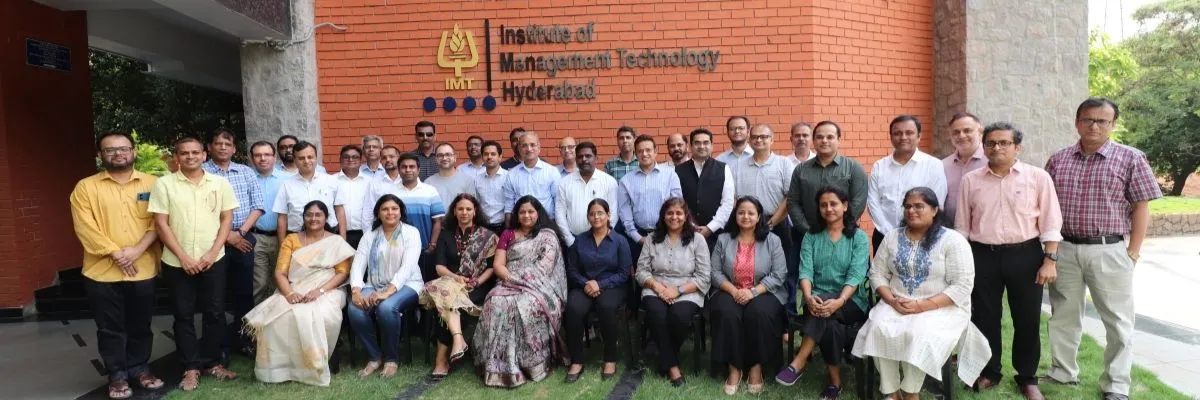
Signatory Spotlight: Institute of Management Technology Hyderabad, Hyderabad, India
 Philadelphia, United States
Join PRME at the 86th Annual Academy of Management in Philadelphia
 England, United Kingdom
Beyond Sustainability Content: Scaling Responsible Futures Education and Research
