Access

- Submit your institution’s Sharing Information on Progress (SIP) Report
- Access SIP reporting across institutions

Access
Access

The 2026 PRME Pedagogy Certificate Series is a global professional development opportunity for educators seeking to advance and certify their pedagogical practice in responsible management education. Designed for those looking to deepen their teaching beyond content delivery, the programme focuses on how we teach: equipping faculty with the tools, mindsets, and approaches needed to cultivate meaningful, future-oriented learning environments.
Through a five-week programme, participants will engage with pedagogical approaches shaping business education today, including systems thinking, regenerative business, cultural intelligence, active and experiential learning, student agency, and the design of reflective and regenerative learning communities. The series emphasizes practical application, enabling educators to translate these approaches directly into their classrooms while engaging with a global community of peers navigating similar challenges and opportunities.
Offered in two cohorts to support global participation, the programme will feature five, two-hour sessions that combine structured learning with flexibility. Participants follow a consistent weekly journey, engaging in live sessions designed to foster dialogue, exchange, and community, alongside on-demand access to support continuity. Throughout the series, the focus remains on building pedagogical confidence, expanding instructional practice, and contributing to a broader shift toward more responsible, inclusive, and innovative management education.
This programme is designed for educators and practitioners at different stages of their teaching journey, including:
Faculty seeking to strengthen or refresh their pedagogical approach
Early-career educators building confidence in the classroom
Experienced instructors redesigning courses or programmes
Programme directors and curriculum leads embedding responsible management education
PRME Champions, Working Group members, and engaged community participants, as well as those looking to deepen their engagement in the PRME community
By the end of the programme, participants will be able to:
Design learning experiences that integrate systems thinking and regenerative approaches
Facilitate active, experiential, and culturally responsive classroom environments
Apply creative and reflective pedagogical methods to support student engagement
Foster student agency and co-creation in learning processes
Critically engage with AI and emerging tools in educational settings
Translate pedagogical innovation into their own institutional contexts
The programme offers two certificate pathways designed to recognize different levels of Participation and Applied Practice. Both pathways support educators in engaging with the full five-week learning journey while providing flexibility for those who wish to deepen their learning through reflection and implementation.
Awarded to participants who:
Complete the introductory session
Attend all five sessions within their scheduled weekly timeframe
This pathway recognizes active engagement in the full learning experience and is well suited for those looking to strengthen their pedagogical knowledge and practice through participation and exchange.
Awarded to participants who:
Complete the introductory session
Attend all five sessions, either live or on-demand, within their scheduled weekly timeframe
Engage in weekly discussion and reflection through PRME Commons, completing the requirements within their weekly timeframe
Submit a final capstone by uploading evidence to PRME Commons demonstrating application of learning (by December 1, 2026)
This pathway is designed for educators who want to move beyond engagement and demonstrate how they are applying and reflecting on pedagogical approaches in their own teaching. It provides an opportunity to document practice and contribute to a shared body of knowledge within the PRME community.
The Certificate of Participation is awarded to participants who demonstrate consistent, high-quality engagement across the series.
Participants are expected to engage fully with all five sessions, either live or through complete review of session recordings within their weekly timeframe.
Engagement should be sufficient to:
Support informed and thoughtful contributions to discussion
Engage critically with the pedagogical approaches introduced
The Certificate of Applied Practice is awarded to participants who demonstrate consistent, high-quality engagement across the series and clear evidence of applied pedagogical practice.
This certificate reflects the substance, integrity, and credibility of a participant’s contributions. Requirements are assessed based on how participants engage with the learning environment and how clearly that learning is translated into practice.
Participants must meet all of the following requirements.
1. Complete Engagement with Weekly Sessions
Participants are expected to engage fully with all five sessions, either live or through complete review of session recordings within their weekly timeframe.
Engagement should be sufficient to:
Support informed and thoughtful contributions to discussion
Engage critically with the pedagogical approaches introduced
Inform the development of applied teaching practice
2. Contribute Consistently to PRME Commons
Participants must engage in the PRME Commons discussion space across the duration of the programme. This includes completeing mandatory engagement posts and responses weekly before the next session begins.
At minimum, this includes:
One original post
Three responses to peers
Contributions should reflect ongoing participation across weeks and align with the progression of the series.
3. Demonstrate Substantive Engagement in Discussions
Discussion contributions are assessed on their substance, relevance, and contribution to the learning community.
Contributions should:
Demonstrate clear engagement with session content
Reflect on application within a defined teaching context
Introduce considered perspectives, questions, or examples
Engage with peers in ways that develop and extend discussion
Strong contributions often:
Connect pedagogical approaches to disciplinary or institutional contexts
Surface tensions, challenges, or implementation considerations
Build on peer contributions to deepen shared understanding
Contributions that lack depth, specificity, or clear connection to the series content will not meet the required standard.
4. Submit a Capstone Teaching Artifact
Participants must submit a capstone artifact that demonstrates applied pedagogical practice informed by the series. The capstone should be submitted on PRME Commons as evidence in the 2026 PRME Pedagogy Certification Series | Capstone Submission discussion board by 1 December 2026.
Submissions should clearly demonstrate:
A defined teaching intervention, design, or adaptation
The reasoning behind key pedagogical choices
Alignment with responsible management education principles
How the approach functions, or is intended to function, in practice
Acceptable formats include, but are not limited to:
Course or module redesigns
Lesson plans or structured teaching sessions
Classroom exercises or experiential learning activities
Assessment strategies or evaluation approaches
Teaching materials with accompanying explanation
Reflections grounded in concrete examples of implementation
Submissions should communicate how pedagogical decisions are made and how they translate into practice.
5. Apply Learning in Practice
Participants are expected to demonstrate that learning from the series has been:
Engaged with in a sustained way
Considered critically
Applied intentionally within a teaching context
Evidence of application should be visible across both discussion contributions and the capstone submission.
Assessment
All requirements are assessed on a pass/fail basis.
The Certificate of Applied Practice is awarded to participants who:
Meet all minimum thresholds
Demonstrate sustained, high-quality engagement
Provide credible evidence of applied teaching practice
Participants whose engagement does not meet the expectations outlined above may receive the Certificate of Participation where applicable. Participants who do not meet minimum thresholds will not receive certification.
The 2025 Certification Programme has been completed. This page details the evidencing requirements for participants who are still pursing a 2025 Certificate of Excellence through June 2026.
Our 2025 pedagogy certificates are more than just a recognition of participation, they’re a way to demonstrate growth, practice, and excellence in responsible management education. That’s why, beyond the Certificate of Participation, the Certificate of Practice and Certificate of Excellence ask for evidence of your work.
Evidence helps ensure that these certificates truly reflect the skills and impact you bring into the classroom. By sharing this, you not only validate your achievement but also contribute to a growing community of educators who are learning from one another.
Submissions have moved from a form to a dynamic discussion board to encourage reflection, exchange, and shared learning. We encourage you to submit to the 2025 PRME Pedagogy Certification Evidencing Board. If you need access to a PRME Commons Member account, please reach out to your PRME account administrator to receive an invitation.
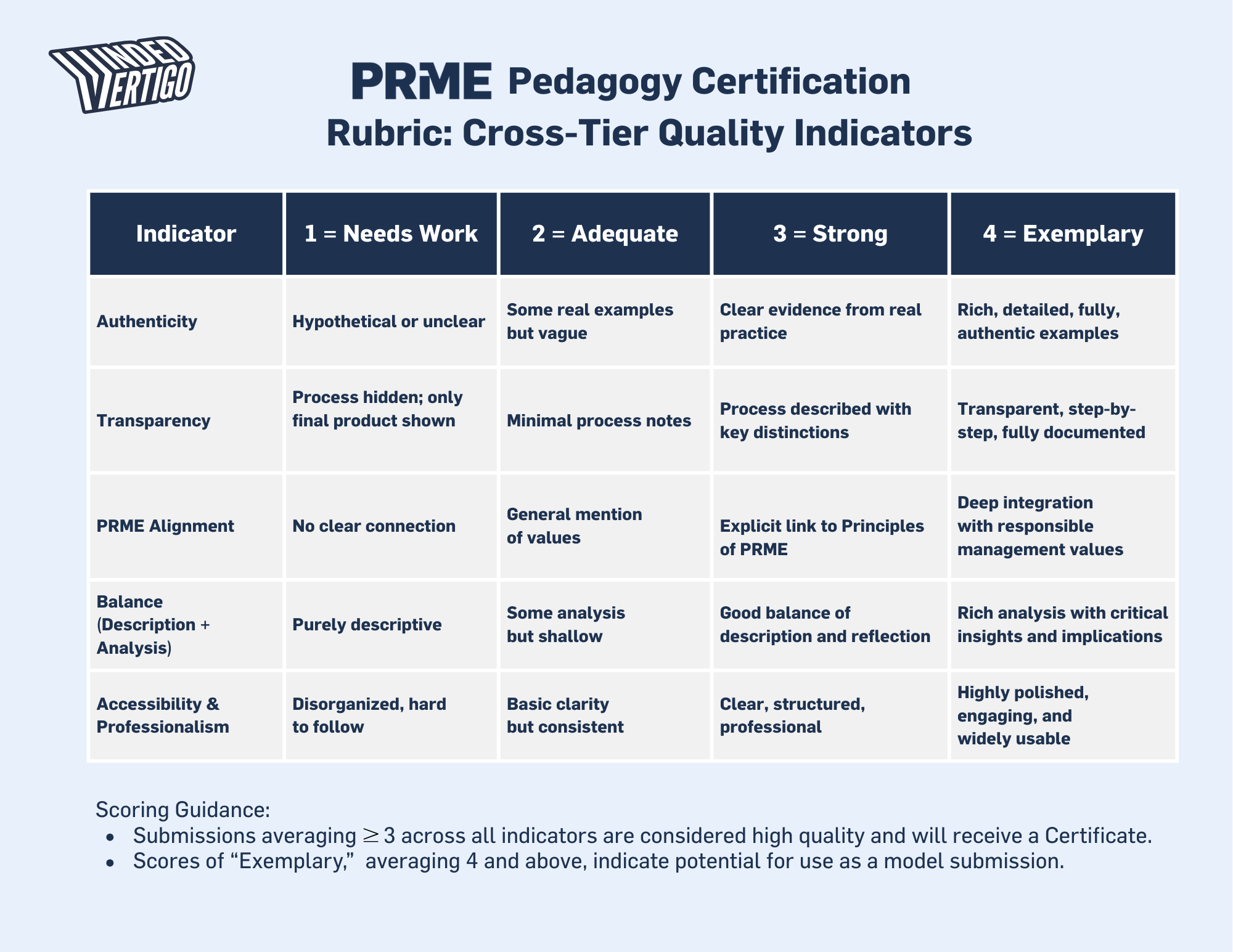
Criteria for High-Quality Submissions of Evidence
We will review the quality of evidence according to the following criteria, which will be applied to both tiers of certificate submissions (Practice & Excellence).
A High-Quality Submission Should Be:
Evidence comes directly from real classroom or institutional practice, not hypothetical examples.
Materials demonstrate actual implementation (lesson plans, student work, outcomes).
The process is clearly documented, not just the polished end product.
Shows how decisions were made, what resources were used, and what steps were taken.
Explicitly connects evidence to the values of responsible management education.
Demonstrates how the pedagogy promotes responsibility, ethics, sustainability, and inclusion.
Goes beyond what happened to explain why it matters.
Includes critical reflection on successes, limitations, and lessons learned.
Materials are well-organized, easy to follow, and free of unnecessary jargon.
Evidence is presented in formats accessible to diverse audiences (e.g., clear slides, annotated notes, structured documents).
Certificate of Excellence Evidence Submission
Those who wish to attain the certificate of Excellence shall choose two from the following three outputs as evidence of tangible student outcomes:
Examples: anonymized assignments, project reports, presentations, design prototypes, or creative outputs.
Examples: short survey results, reflective journal excerpts, or quotes from students about their learning experience.
Examples: pre/post assessments, rubric scores, participation metrics, or skill progression (quantitative or qualitative).
This certification is exclusively for PRME Signatory Members and offered free of charge.
The Certificate workshops are designed in a new format by experts from winded.vertigo and meant to see educators leave with engaging activities and conversations they can use in the classroom. If you were certified in 2025, we welcome you to join us again in 2026!
All workshops are 2 hours with an optional 15 minute Q&A.
All of our sessions will be recorded and available on-demand. If you cannot make a live session, you must watch the on-demand to receive attendance credit. You still need to register and complete the introduction session to enroll.
The PRME Secretariat will be tracking participation in all the sessions for the Certificate of Participation. Once you've met the requirements, your certificate will be issued in 2- 3 weeks.
Great! We recommend you engage in the Certificate Series to receive tools and facilitation guides you can take back to your university and/or school. If you have additional questions, please reach out to pedagogy@unprme.org.
Yes! If you have any feedback, please share it with us at pedagogy@unprme.org.
Each session will have a 15 minute Q&A at the end to answer any questions you may have. If your question is not answered there, or in the FAQs, please write to us at pedagogy@unprme.org.