Access

- Submit your institution’s Sharing Information on Progress (SIP) Report
- Access SIP reporting across institutions

Access
Access


 Oslo, Norway
Share


By Caroline D Ditlev-Simonsen, Professor at BI Norwegian Business School; Dr Jill Bogie, Director of the GIBS Sustainability Initiative Africa at the Gordan Institute of Business and Science, University of Pretoria, South Africa and Flávio Hourneaux Junior, Professor at the School of Economics, Management, Accounting and Actuarial Science at the University of Sao Paulo, Brazil
Ask deans and CEOs whether business schools and corporations should work together on sustainability and you’ll get the same answer: of course. In practice though, collaboration lags. Two UN-affiliated networks exist with aligned ambitions to support collective action on the UN SDGs: the UN Global Compact (UNGC),a corporate network with 20,000 members, and the Principles for Responsible Management Education (PRME), the UNGC education initiative launched in 2007 that operates within UNGC as a parallel network, now with 800 member business schools.
Used together strategically, they could be a force multiplier for sustainability impact. Use separately, they risk becoming parallel monologues. In the spirit of SDG 17—Partnerships for the Goals—collaboration should be systemic, not episodic.
UNGC gives companies an on-ramp—ten principles on human rights, labor, environment, and anti-corruption, CEO-level commitment, annual reporting, and action through national Country Networks. PRME offers the academic mirror: schools commit to embedding responsible management across seven principles—purpose, values, teach, research, partner, practice and share and submit Sharing Information on Progress (SIP) reports (biennially before 2024; annually thereafter). Both have strong local and regional structures—Global Compact Country Networks and PRME Chapters—that should make collaboration practical.
On paper, that’s a perfect handshake. In reality, it’s often a wave from across the room. When Nordic PRME schools went looking for working models with their local UNGC networks, they found remarkably few examples—evidence of a “missed opportunity” and a need to study where the bridges do exist.
Two cases in this article show what’s possible—and what’s missing. At the University of Pretoria’s Gordon Institute of Business Science (GIBS), proximity, senior-level support, and a motivated “translator” (a boundary-spanning faculty leader) turned PRME intent into concrete collaboration with Global Compact Network South Africa: co-location, programmatic ties (e.g., Champions activities), and shared events. This emergent, agile model yielded deeper engagement and even formal participation in UNGC and PRME governance—proof that the handshake can be firm when someone owns it.
Brazil’s FEA-USP illustrates a more networked route: collaboration flowed through PRME Chapter Brazil, enabling broad participation and collective action with Global Compact Network Brazil. The architecture is sturdy, but institution-specific projects and outcomes remain uneven— momentum without full translation to the core of the school.
Why is the middle missing? This analysis points to enablers and gaps rather than a single recipe. Enablers include motivated, strategically positioned “translators,” supportive institutional environments, and alignment between school and network goals; proximity (physical or structural via Chapters) helps but is not sufficient without intentional strategies. Conversely, uneven internal implementation of PRME, resource constraints (especially for smaller schools), and the absence of clearly defined joint agendas weaken partnerships.
What to do next
There’s no shortage of goodwill. But goodwill without structure—and without agency—is just a nice meeting. UNGC supplies companies with clarity, commitments, and local networks. PRME gives schools principles, peers, and legitimacy to redesign management education. In the spirit of SDG 17, the missing link is a routine, accountable, local handshake—but more than symbolic cooperation. The key is starting with a concrete project in the local context—one that delivers clear value to both networks—backed by agency and energy, so that every semester begins with new initiatives, every project feeds back into learning, and every partner can point to progress that outlives the press release. Boundary spanners operate in this agency space: translating aims across institutions, borrowing what works, adapting it to context, and creating momentum that drives them to the next initiative. Once structures are established, they move on to catalyze something new, maintaining forward energy that builds sustainable collaboration beyond individual projects. That’s how we close the middle: by supporting translators, using existing networks, aligning with strategy, mobilising research, and making working models easy to find, adapt, and copy. Encouragingly, the shift toward such partnership practice is underway via PRME.
The full chapter is available here: https://juristforlaget.bokorder.se/sv-se/article/5440/festskrift- till-katarina-olsson
Authors:
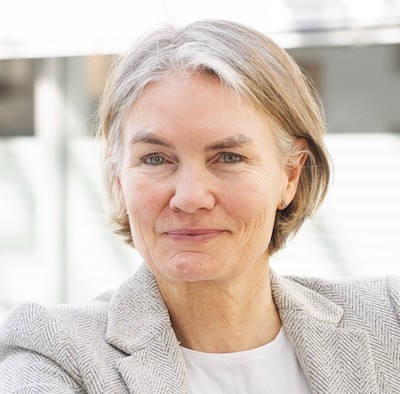
Caroline D Ditlev-Simonsen, Professor at BI Norwegian Business School
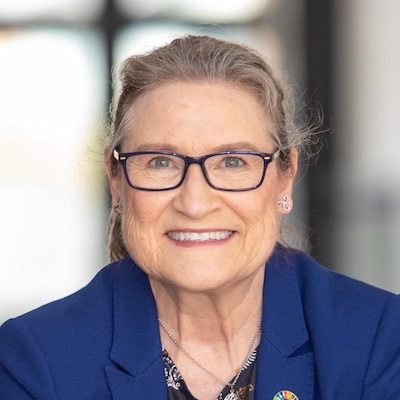
Dr Jill Bogie, Director of the GIBS Sustainability Initiative Africa at the Gordan Institute of Business and Science, University of Pretoria, South Africa
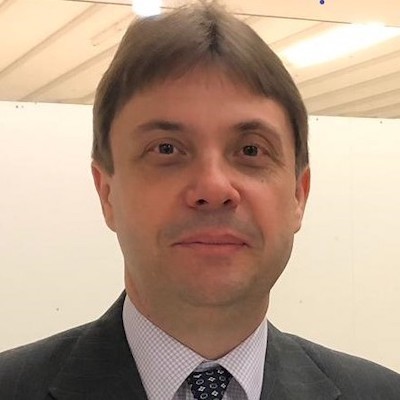
Flávio Hourneaux Junior, Professor at the School of Economics, Management, Accounting and Actuarial Science at the University of Sao Paulo, Brazil
Share
New York, United States
PRME Recognizes Global Student Leaders Advancing Sustainability through Innovation and Impact
 Cairo, Egypt
Recognition of Excellence in SIP Reporting Recipients
 Cairo, Egypt
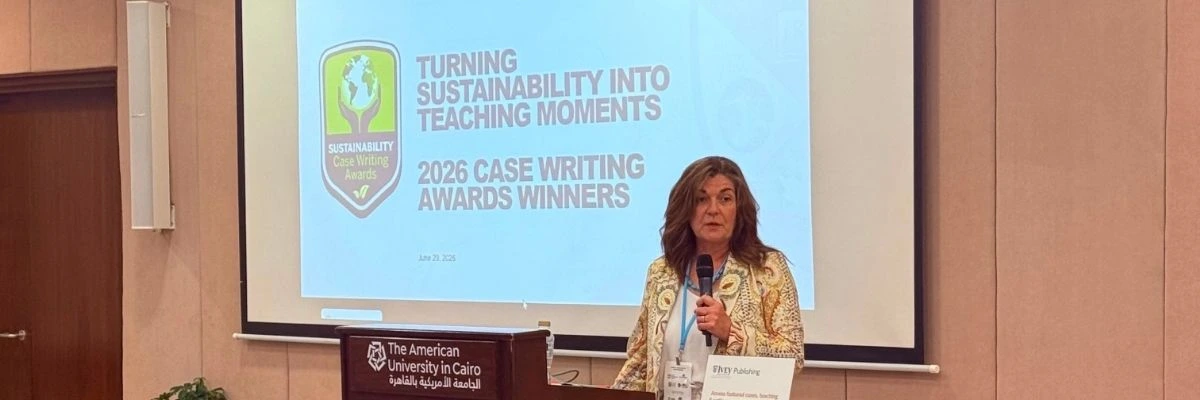
Educators from Around the World Recognized in Cairo for Excellence in Sustainability Case Writing