Access

- Submit your institution’s Sharing Information on Progress (SIP) Report
- Access SIP reporting across institutions

Access
Access

History
This Working Group emerged from the years of ongoing conversations and joint projects among educators and researchers exploring the role of arts in responsible management education. As the world navigates a polycrisis of interconnected challenges across climate, inequality, conflict, societal polarization, the Working Group recognizes that conventional pedagogies often struggle to cultivate empathy, reflection, and systems thinking. Arts-based approaches offer powerful pathways to widen perspectives, present complex issues in more intuitive expressions and engage learners in a holistic way, cognitively, affectively and behaviorally.
Purpose
Over the past four decades foundational work has been undertaken by individual educators and researchers establishing the field of organizational aesthetics, art firms and sensuous learning (e.g. Pierre Guillet de Monthoux, Steven S. Taylor, Nancy J. Adler, Paul Shrivastava, Elena P. Antonacopoulou) but there is a lack of sufficient institutional visibility, structured frameworks and a need for more research at the intersection of RME and arts. This Working Group attempts to respond to this gap by addressing the need to recognize art as a pedagogical tool and to build awareness among educators starting from the PRME community.
By foregrounding empathy, creativity, and inclusivity, the Working Group aims to strengthen the human core of PRME-aligned learning and reimagine how responsible leadership is cultivated in management classrooms worldwide. The Working Group seeks to position art and arts-based pedagogies as powerful enablers of responsible management education also by enabling learners to disrupt taken-for-granted assumptions and to imagine alternative futures.
Goals
The Working Group serves as a vital bridge between creative expression of educators as artists and academics and responsible management education. The Working Group’s primary goal is to harness the power of art and creativity to raise awareness of urgent sustainability issues, transforming complex data into evocative narratives that inspire immediate action among students, educators and other stakeholders.
Recognizing that sustainability is inherently cultural, we leverage artistic inquiry to reflect diverse societal attitudes and foster equity. The goals of the Working Group are:
1. Raise awareness among educators about the pedagogical value of art in fostering empathy, reflection, and responsible leadership;
2. Research and disseminate classroom and outside of classroom practices, case experiences, and innovative experiential learning and arts-based pedagogical methods through publications, creative outputs and outreach events;
3. Develop practical toolkits, frameworks, and teaching resources that enable adoption of arts-based pedagogies across institutions and other capacity building initiatives.
4. Empower students and youth through inclusive platforms that celebrate creative problem-solving enabled by arts for impact.
Research
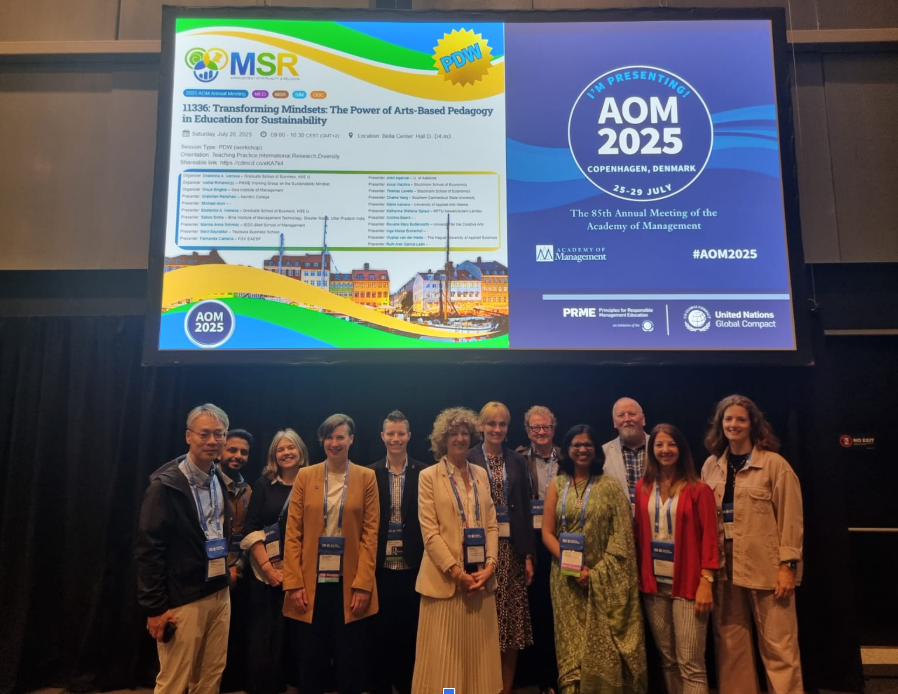
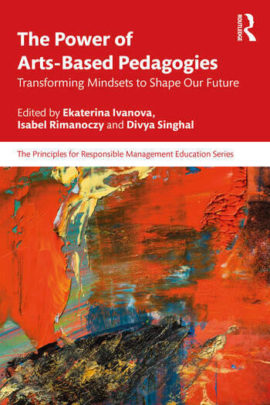
The Working Group will advance collaborative research on how arts, creativity and arts-based pedagogies transform mindsets for responsible management learning. Even prior to its formal establishment, a key outcome in 2026 has been the publication of a Routledge volume in the PRME Series on arts-based pedagogies and mindset transformation, demonstrating both scholarly interest and practical relevance in this space. This collaborative effort was recognized as the best professional development workshop (PDW) by the MED Division of the Academy of Management at the annual meeting held in Copenhagen in 2025. The call for book chapters, edited by the co-chairs of the Working Group, in the new release of the book in the PRME series is planned by the end of 2026.
Building on this momentum, members will document classroom and outside of the classroom innovations, develop case studies and teaching notes, and co-author articles, immersive events, social media posts, and roundtable reflections that make these practices visible to the wider RME community. The group will encourage joint submissions to the leading academic journals in management education, sustainability, and ethics, and curate thematic tracks, special issues, panels, and workshops at leading international conferences, such as Academy of Management (AOM), Responsible Management Education Research (RMER) Conference, etc. Cross-institutional research collaborations and cross PRME Chapters (e.g. PRME Chapter Eurasia, DACH, North America, India) cooperation will be fostered to build evidence on the impact of arts-based approaches in advancing PRME outcomes.
Engagement Opportunities
The Working Group will create regular opportunities for educators, students, researchers, artists, and art institutions to connect through quarterly online meetings, experience-sharing forums, social media and practice showcases. Workshops and training sessions will enable members to learn how to apply arts-based methods in classrooms and institutional initiatives.
Two tangible platforms for 2026 include:
E-Art Exhibition: The Inconvenient Truth about Sustainable Business
Hosted by the College of Management, Mahidol University, in April 2026, this global exhibition invites students and artists from around the world to explore sustainable business through artistic expression..
Sustainable Fashion Show
osted by Faculty of Business,Leeds University Business School, in May 2026, this initiative will host a creative take for the Faculty’s annual Sustainability Day, engaging staff, students, alumni and global communities to reflect on their consumption habits. We invite colleagues from Business Schools around the world committed to arts-based approaches to come on board and support this project. For more information regarding this event, please write to Dr Sally Chan (LUBS PRME Lead) at s.s.y.chan@leeds.ac.uk
The Working Group will also organize joint webinars and dialogue series with partners such as the Network for Business Sustainability and the Global Business School Network, along with other interested institutions.
Resource Development
The Working Group will create practical resources that enable educators to adopt arts-based approaches in responsible management education. These will include books, case studies, and best-practice compendiums and other creative output etc. contributed by members across institutions. Recognizing the importance of social media in knowledge dissemination, the group will actively use a dedicated LinkedIn page from its day of inception to share resources, experiences, and curated examples of arts-based learning. This will strengthen the community and help extend the reach of the Working Group beyond formal academic channels and create an ongoing, visible stream of ideas, practices, and inspiration for responsible management educators and practitioners worldwide.
Stay tuned for additional resources to be uploaded in the resources tab!
Other Activities
Collaborative Initiatives
Additional activities may include arts-based student competitions in collaboration with PRME Students. Additionally, collaborations with PRME Working Groups, such as Sustainability Mindset, and PRME Chapters, such as Eurasia, DACH, North America, India will be expanded through joint events, collaborative research, cross-chapter dialogues to advance art-based pedagogies in responsible management education.
Where relevant, the Working Group will facilitate collaborations with artists to co-create learning experiences, exhibitions, and reflective engagements that bring societal and environmental issues into management classrooms through creative expression.
Podcast
Through the Stakeholder Podcast by Prof. Ed Freeman and Mahidol University’s sustainability Podcast, the Working Group will co-produce a series of episodes that examine this stakeholder group and explore the potential impact of art on responsible business education and experiential learning. Pending audience engagement, this initiative has the potential to develop into a regular podcast series with sustained outreach and educational value.
Co-Chairs
Divya Singhal, Goa Institute of Management, India
Ekaterina Ivanova, Graduate School of Business HSE, University, Russia
Steering Committee
Sally Chan, Faculty of Business, University of Leeds, UK
Nattavud Pimpa, College of Management, Mahidol University, Thailand
Valli Batchelor, School of Business, Monash University, Australia
Fernanda Carreira, FGV, Brazil
Stephan Sonnenburg, ICN Berlin Business School, Germany
Please fill out the form here to join the Working Group.
Please join our dedicated LinkedIn page to access and share resources, experiences, and curated examples of arts-based learning.
 URL
URL
An increased understanding of art and art-based-methods is needed to address the behavioral and cultural change in the sustainability transition. This edited collection explores ways to engage people in their citizen, consumer, employer, employee and entrepreneurial roles, as they grapple with the sustainability transition. It introduces art and arts-based methods to advance sustainability thinking.
Lehtimäki, H., Taylor, S. S., & Lyra, M. G. (2024). Art and Sustainability Transitions in Business and Society: Theoretical Insights and Engagement: Springer Nature.
Honing Self-Awareness of Faculty and Future Business Leaders emphasizes self-awareness and management of emotions as a strong differentiator for generating student engagement, well-being and performance in complex and ambiguous societal and economic VUCA environments.
Honing Self-Awareness of Faculty and Future Business Leaders emphasizes self-awareness and management of emotions as a strong differentiator for generating student engagement, well-being and performance in complex and ambiguous societal and economic VUCA environments.
Kumar, P., Culham, T., Major, R., & Peregoy, R. (2023). Honing Self-Awareness of Faculty and Future Business Leaders: Emotions Connected with Teaching and Learning. Bingley, UK: Emerald.
Curating Capitalism: How Art Impacts Business, Management, and Economy: Sternberg Press.
Curating has evolved into much more than creating interesting exhibitions, promoting artists, and caring for artworks: in this millennium, art and business are fused, transforming capitalism from the inside out. Curating Capitalism implies new ways of management far beyond the simple commercialization of art and artist. Today, art and the artist inspire business. Beginning with Joseph Beuys’s declaration ART = CAPITAL and Andy Warhol's vision of a capitalistic BUSINESS ART, Pierre Guillet de Monthoux contemplates the insights of contemporary curators to understand the new hybrid forms of art and business active in our current society and economy.
De Monthoux, P. G. (2022). Curating Capitalism: How Art Impacts Business, Management, and Economy: Sternberg Press.
Teaching Business Through an Artful Lens
This article shares the use of artistic practices such as music, theater, painting, and storytelling to help students see issues through multiple lenses and engage more deeply with complex challenges like sustainability and inequality. Examples from institutions worldwide show how arts-based pedagogy enhances learning, leadership development, and interdisciplinary understanding
Weybrecht, G. (2022). Teaching Business Through an Artful Lens. AACSB.
The multi-stakeholder panel fosters dialogues on the importance of arts in various issues e.g. human rights, climate challenge and discusses various examples of arts integration into the business school curricula and other activities to advance the 2030 agenda. What does art have to do with social change? Find out why it plays a vital role in society in GBSN's Beyond virtual conference. Join Katell Le Goulven, PhD alongside Divya Singhal, Fernanda Carreira, Okan Pala and Abby Litchfield as they explore the impact that the arts can have in human rights, climate decline, and other challenges facing people and the planet.
GBSN. (2021, Nov 15-17). Art as a vehicle for social changes: Stakeholder dialogue at GBSN Beyond [Video]. YouTube.
Sensuous Learning for Practical Judgment in Professional Practice: Volume 1: Arts-based Methods
The first volume of this ground-breaking book critically examines how and why arts-based methods such as choir conducting workshops and dialogue improvisation can make a difference in improving professional practice. Taking a ‘human-centred’ approach, it delivers an insightful account of what these approaches do differently to achieve a new mode of learning – ‘sensuous learning’ – that cultivates professional judgment to serve the common good, simultaneously supporting personal and collective growth.
Antonacopoulou, E. P., & Taylor, S. S. (2019). Sensuous Learning for Practical Judgment in Professional Practice: Volume 1: Arts-based Methods (Vol. 1). Cham: Springer.
The second volume of this ground-breaking book critically examines the effect of arts-based methods in combination as arts-based interventions in improving professional practice, from deinstitutionalization to the counteraction of destructive leadership. Taking a ‘human-centred’ approach, it delivers an insightful account of what these approaches do differently to achieve a new mode of learning – ‘sensuous learning’ – that cultivates professional judgment to serve the common good, simultaneously supporting personal and collective growth.
Antonacopoulou, E. P., & Taylor, S. S. (2019). Sensuous Learning for Practical Judgment in Professional Practice: Volume 2: Arts-Based Interventions (Vol. 2): Springer
Developing a sustainability mindset requires a transdisciplinary approach to business education that integrates a rational-analytic mode of thinking and an emotive-holistic understanding of the human mind. In order to cultivate the sustainability mindset of business students, we have designed a contemplative art-based project involving the creation of an electronic portfolio which consists of a student's digital photographs. The project aims to enable business students to become more visually attentive and environmentally conscious, so that they will pay close attention to the process of building more sustainable relationships within their natural and social environments.
Yang, C., Ivanova, E., & Hufnagel, J. (2021). Using Contemplative Photography in Transformative Sustainability Management Education: Pedagogical Applications in the United States, Russia, and Germany. The International Journal of Management Education, 19(3), 100568.
The Arts & Leadership: Now that We Can Do Anything, What Will We Do?
Given rapid changes across society, the economy, and technology, 21st-century organizations must adopt more spontaneous and innovative management approaches. The author examines why a growing number of companies are integrating artists and artistic processes into their strategic and everyday management practices, as well as into leadership development.
Adler, N. J. (2006). The Arts & Leadership: Now that We Can Do Anything, What Will We Do?. Academy of Management Learning & Education, 5(4), 486-499.
10 April 2026 08:00 AM - 09:20 AM
PRME Working Group on Arts for Impact
The Power of Arts-Based Pedagogies: Transforming Mindsets to Shape Our Future
Location: Online
We are delighted to invite you to the global launch of the book, The Power of Arts-Based Pedagogies: Transforming Mindsets to Shape Our Future, authored by the PRME community members around the world on Friday, 10 April 2026, at 8:00 am ET....