Access

- Submit your institution’s Sharing Information on Progress (SIP) Report
- Access SIP reporting across institutions

Access
Access

Joining PRME is a meaningful step for institutions committed to advancing sustainability and responsible management education. Membership signals to students, faculty, and external stakeholders that your institution is serious about preparing future leaders who can navigate complex global challenges responsibly. Once a Signatory Member, a number of opportunities are unlocked:
A Network of 800+ like-minded institutions: Collaborate on projects with dynamic local and global learning communities from around the world (200,000+ faculty in 800+ institutions across 90+ countries) driving positive change in business practices and fostering a community dedicated to responsible management education.
Faculty development and resources: Engage in comprehensive programmes, certifications, and trainings that provide educators with the tools and knowledge needed to stay at the forefront of sustainable business practices while also advancing professionally in their career.
Equip your students for global impact: Access resources, programmes, and leadership opportunities which prepare your future graduates with the skills and knowledge to drive positive change, foster sustainability, and make a lasting difference on a global scale, ensuring they are well-positioned for success and social impact in their careers.
Entry point to UN ecosystem: Distinguish your institution as leaders in responsible management education by upholding and adhering to the values of the United Nations while amplifying your impact on the world stage.
Interactive programs and high-level events: Immerse yourself in thought-provoking discussions, workshops, and conferences (such as the PRME Global Forum, Thought Leadership Summit, or side events alongside the United Nations General Assembly), all designed to connect you with the latest insights and strategies in responsible management education.
Track and share your commitment to Responsible Management Education: PRME’s Sharing Information on Progress (SIP) Reporting provides a structured framework to assess your impact, set meaningful benchmarks, and demonstrate your commitment to responsibility in business education.
The growth and impact of the Principles for Responsible Management Education (PRME) initiative is made possible by the engagement of over 800 Signatory Members and partners from across the world that are committed to a common mission: transforming management education and developing the responsible decision-makers of tomorrow to advance sustainable development. In addition to being a movement, PRME is also a non-profit organization that relies on the generous contributions of PRME Signatory Members to support its mission as well as the Secretariat team, which serves the interests and programmatic work of the community.
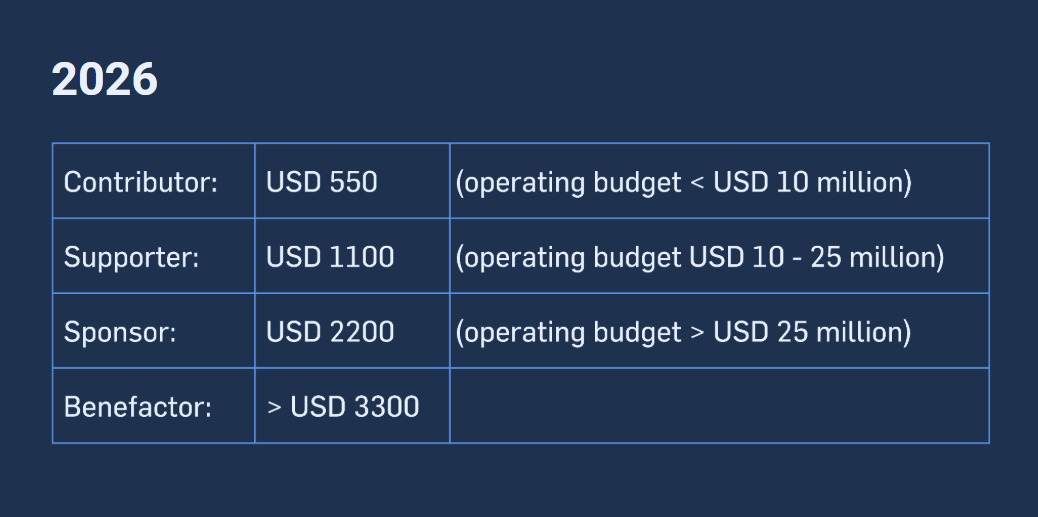
Based on an institution’s operating budget, each Signatory Member will be expected to contribute within their means at their corresponding tier, with no difference in engagement opportunities across tiers. The tiers are adjusted annually to account for inflation and other factors.
This business model ensures PRME has a sustainable long-term plan for lasting impact. We have come to understand that even a small monetary contribution incentivizes in-depth engagement beyond annual reporting.
The intention of an annual contribution is to make Signatory Member participation across the world fair and inclusive. To support the development of the PRME Regional Chapters, a percentage of the global fees is put into a Development Fund and redistributed to Chapters to support their activities.
If you have any questions or concerns regarding the PRME Signatory Membership Model, please reach out to the PRME Secretariat at info@unprme.org.
The Sharing Information on Progress (SIP) is PRME’s annual space for Signatory Members to reflect on, articulate, and share how responsible management education is being advanced in practice. More than a reporting exercise, the SIP supports institutions in making visible the values, priorities, and approaches that shape their work, while contributing to a shared body of learning across the global PRME community. Through consistent, transparent engagement, SIP reporting helps institutions document progress over time, elevate good practice, and participate in an ongoing collective conversation about the future of management education.
PRME requires Signatory Members to submit their SIP report annually by completing the questions and prompts and providing evidence in support of those responses. Reporting is structured to align with work already being done by the institution, and segmented to reflect the values embedded within the Principles of PRME. Within each Principle, the institution answers questions and prompts that address their commitment to that Principle, while uploading evidence, such as attachments, narratives, courses, collaborations, etc., to their response.
The intention of the SIP report is threefold:
Share: Showcase and disseminate your school’s leading practices, innovations, and lessons learned across the PRME community and beyond.
Information: Provide a clear, structured account of how your institution is embedding sustainability and the Principles of PRME, creating a transparent record of activities, initiatives, and outcomes.
Progress: Establish a baseline and enable continuous improvement by tracking goals, actions, and results over time, so you can measure advancement, identify gaps, and strengthen your approach to implementing sustainability and the PRME values year over year.
SIP Reporting in PRME Commons:
Signatories complete their SIPs within PRME Commons, our novel community platform that serves as a self-reporting database and a global knowledge exchange hub for PRME Signatory Members. Locating SIP reporting within a shared digital space allows individual submissions to contribute to a wider body of institutional practice. Together, these reports support transparency, mutual learning, and a more nuanced understanding of responsible management education across the PRME community.
In PRME Commons, SIP reporting enables schools to showcase both narratives and data in a structured, accessible format. Instead of stories and case studies living in isolated documents, Commons helps surface impactful initiatives in ways that are easier to find, understand, and share with relevant stakeholders. This increases visibility, strengthens engagement, and helps good practices travel further than they would through traditional reporting alone.
Through PRME Commons, SIP reporting becomes more than a compliance exercise. It is an opportunity for institutions to articulate their commitments, highlight meaningful practices, and contribute openly to a shared global narrative on responsible management education. By reporting consistently over time, schools strengthen transparency, demonstrate growth, and help shape a collective understanding of what progress looks like across diverse contexts. Making practices visible within Commons elevates work that often lives quietly within institutions, opening pathways for recognition, collaboration, and learning. As a shared space, Commons supports reflection, inspires new approaches, and encourages purposeful engagement across the PRME community.
Hear what others in the PRME community have to say about SIP reporting:
Creating awareness of the mission of PRME and your commitment to it: "We believe that the actual preparation of the report itself can serve as a powerful catalyst for continued change and further recognition of the influence of PRME on campus. The more that people on campus know about how PRME relates to our mission, the more likely they are to take steps to shape activities and programmes that will be aligned with and driven by the Principles." Babson College, United States.
Giving a concise and comprehensive overall picture of your activities: "Preparation of the report has brought to light the impressive number of activities in our College that are PRME-related. Although I track many of these programmes and initiatives, it is always surprising, when seeing it all accumulated, to realise the breadth and scope of these activities, and the large number of faculty, students, administrators and staff involved." The Peter J. Tobin College of Business, St. John's University, United States.
Boosting visibility and reputation: "For us, preparing the PRME report has had tremendous benefits. We have found that the process of gathering data regarding progress and commitments in relation to PRME has made visible very powerful backstage initiatives that are definitively making changes when educating future managers. Therefore, for us PRME has been an instrument of public and social recognition of creative and treasured initiatives that colleagues have silently designed and implemented in order to form socially responsible managers and citizens." Universidad EAFIT, Colombia.
Organising and connecting relevant people across your organisation: "The reporting process has been exceedingly good at organising people who impact sustainability indicators. Because of the reporting process, regular meetings occurred between some of these parties and continue to occur with the future goal of improving our environmental management system." KU Leuven Faculty of Economics and Business, Belgium.
Defining direction and strategy: "This process has enabled valuable critical discussions on the topic of responsible management education and its role across the institution. Putting the report together creates involvement and the final report serves as a proof that PRME activities are conducted beyond the CBS Office of Responsible Management Education and across the organisation... It helps us define our direction and strategy." Copenhagen Business School, Denmark.
Tracking and benchmarking progress: "Completing the SIP report on a yearly basis has facilitated our ability to track our activities, capture and benchmark the breadth of initiatives across campus, and motivate faculty, staff and students to build on these experiences, encouraging them to take them to the next level." Bentley University, United States.
Identifying where more can be done: "We have been able to see the gaps and areas of improvement towards achievement of the Principles and set out improvement plans where we are not doing well. This has also created more awareness and closer engagement with the Principles." KCA University, Kenya.
Fostering a sense of achievement: "Our first audience for the report was internal; it was a way of documenting and celebrating some of the excellent work in which our colleagues are engaged. The more we all learn about the work of our colleagues, the greater the opportunities are for new collaborations between us, and this is at the very heart of our inter-disciplinary School." Glasgow Caledonian University, United Kingdom.
Creating new synergies and collaborations: "Our baseline report gives [readers] a primer on all of the various social impact initiatives and programmes at Berkeley-Haas, which accelerates the conversations we're able to have with our employees, advisors and students. We're able to spend less time explaining who we are and more time focusing on areas of collaboration and growth." The Haas School of Business, University of California Berkeley, United States.
Promoting PRME's impact globally: "Public reporting of SIP ensures the credibility of the PRME initiative and facilitates the exchange of good practices among the PRME network and beyond." Monash University Faculty of Business and Economics, Australia.
After 15 years of SIP Reporting on PRME's Six Principles, we have recognized the importance of the Signatory Members’ SIP Reports as a way of reporting their PRME implementation journey within their institutions and as a way of communicating these advances to internal and external stakeholders. With its implementation in 2008 until today, there are more than 2,800 reports available on our website, evidencing the commitment of Signatory Members within the environment of responsible management education.
During this period, different stakeholders have collaborated for the evolution of sustainability and impact reporting, whether in the higher education or business environment, since multiple frameworks and many metrics are emerging and growing in importance. With the advancement of visibility around the Sustainable Development Goals (SDGs) and environmental, social, and corporate governance (ESG) metrics, these topics have taken the lead in the need to "walk the talk". Building on an era of advancing the PRME Principles, with an action-oriented mindset, a new SIP reporting scheme can strengthen the convergence of responsible management education, impact and responsible business.
Eligibility Criteria
No individual memberships at this time
Provide business or management degrees
Be publicly recognized (i.e. legal/government recognition)
Been in existence for at least two years
Exclusionary Criteria
Subject to a UN sanction
Listed on the UN Ineligible Vendors List for ethical reasons
Derive revenue from the production, sale and/or transfer of antipersonnel landmines or cluster bombs
Derive revenue from the production and/or manufacture of tobacco
Application
To join PRME, interested institutions should fill out an application. The application has 8 steps and takes approximately 10-15 minutes to complete if all the required information has been gathered. A letter of commitment signed by your institution's highest executive (Dean, President, etc) will be required. We are happy to share a template for the Letter of Commitment for your convenience. You can download a PDF of the application questions to help prepare you before you submit here.
After your application is reviewed and approved your institution is ready to set in motion changes to implement the Seven Principles and to inspire and enable a better world through responsible management education:
Engage your designated points of contact in PRME programs and invite other colleagues to participate in events and other member benefits.
Contribute to the PRME Annual Contribution Fee.
Begin preparing for your institution's Sharing Information on Progress (SIP) report.
Engage further in the PRME community! Connect with your local PRME Chapter; get involved in an issue-area Working Group; check out upcoming activities and events taking place.

 pdf
pdf
