Access

- Submit your institution’s Sharing Information on Progress (SIP) Report
- Access SIP reporting across institutions

Access
Access

The Sharing Information on Progress (SIP) is PRME’s annual space for Signatory Members to reflect on, articulate, and share how responsible management education is being advanced in practice. More than a reporting exercise, the SIP supports institutions in making visible the values, priorities, and approaches that shape their work, while contributing to a shared body of learning across the global PRME community. Through consistent, transparent engagement, SIP reporting helps institutions document progress over time, elevate good practice, and participate in an ongoing collective conversation about the future of management education.
PRME requires Signatory Members to submit their SIP report annually by completing the questions and prompts and providing evidence in support of those responses. Reporting is structured to align with work already being done by the institution, and segmented to reflect the values embedded within the Principles of PRME. Within each Principle, the institution answers questions and prompts that address their commitment to that Principle, while uploading evidence, such as attachments, narratives, courses, collaborations, etc., to their response.
The intention of the SIP report is threefold:
Share: Showcase and disseminate your school’s leading practices, innovations, and lessons learned across the PRME community and beyond.
Information: Provide a clear, structured account of how your institution is embedding sustainability and the Principles of PRME, creating a transparent record of activities, initiatives, and outcomes.
Progress: Establish a baseline and enable continuous improvement by tracking goals, actions, and results over time, so you can measure advancement, identify gaps, and strengthen your approach to implementing sustainability and the PRME values year over year.
SIP Reporting in PRME Commons:
Signatories complete their SIPs within PRME Commons, our novel community platform that serves as a self-reporting database and a global knowledge exchange hub for PRME Signatory Members. Locating SIP reporting within a shared digital space allows individual submissions to contribute to a wider body of institutional practice. Together, these reports support transparency, mutual learning, and a more nuanced understanding of responsible management education across the PRME community.
In PRME Commons, SIP reporting enables schools to showcase both narratives and data in a structured, accessible format. Instead of stories and case studies living in isolated documents, Commons helps surface impactful initiatives in ways that are easier to find, understand, and share with relevant stakeholders. This increases visibility, strengthens engagement, and helps good practices travel further than they would through traditional reporting alone.
Through PRME Commons, SIP reporting becomes more than a compliance exercise. It is an opportunity for institutions to articulate their commitments, highlight meaningful practices, and contribute openly to a shared global narrative on responsible management education. By reporting consistently over time, schools strengthen transparency, demonstrate growth, and help shape a collective understanding of what progress looks like across diverse contexts. Making practices visible within Commons elevates work that often lives quietly within institutions, opening pathways for recognition, collaboration, and learning. As a shared space, Commons supports reflection, inspires new approaches, and encourages purposeful engagement across the PRME community.
SIP reporting is the primary way PRME Signatories communicate how responsible management education is being embedded across their institutions. Through annual reporting, schools share progress, reflect on priorities, and contribute openly to a global narrative on sustainability, ethics, and responsibility in management education. The SIP provides a structured yet flexible space for institutions to document their work, highlight meaningful practices, and demonstrate how the Principles of PRME are shaping strategy, teaching, research, and engagement. The SIP reports are publicly available on the PRME website, allowing schools to share a direct link across internal and external communications.
Support for Accreditation and Rankings
Just as importantly, SIP reporting can reduce duplicati
on of the data collection and reuse process across the growing landscape of accreditation, reporting, and rankings. Much of what schools document for the SIP, such as how sustainability is embedded in strategy, curriculum, research, partnerships, and operations, overlaps with the types of evidence increasingly requested by major quality assurance and benchmarking systems.
For example, AACSB’s standards and guidance emphasize ethics, social responsibility, and societal impact, all of which benefit from consistent internal documentation and clear narratives. Similarly, EFMD’s EQUIS process has embedded ethics, responsibility, and sustainability into its assessment approach, making it useful for schools to have a structured way to evidence how these commitments show up across the institution. Beyond accreditation, sustainability-focused benchmarking is also increasingly data-driven. THE’s Impact Rankings assess universities’ contributions to the SDGs across areas such as research, stewardship, outreach, and teaching, based on submitted indicators and evidence. And major business school rankings are incorporating sustainability-related dimensions. For instance, the Financial Times includes measures related to ESG teaching and, in some rankings, carbon footprint methodology components, reinforcing the value of having credible, well-organized information on how sustainability is taught and operationalized.
Explore how PRME supports business schools with Accreditation and Rankings
Collective Learning
Within the PRME community, SIP reporting also contributes to PRME’s collective learning and global evidence base. The annual PRME Global Insights Report draws on SIP reports submitted digitally through PRME Commons to provide an evidence-based snapshot of how responsible management education is advancing across institutional contexts, highlighting shared priorities and emerging trends. In other words, each SIP strengthens not only your school’s story, but also the field’s ability to understand what is happening globally and where support, innovation, and collaboration are most needed.
Continuous Improvement
Finally, the SIP is most powerful when it is treated as a tool for continuous improvement, not a one-time submission. In practice, the process is designed to move from reporting to action:
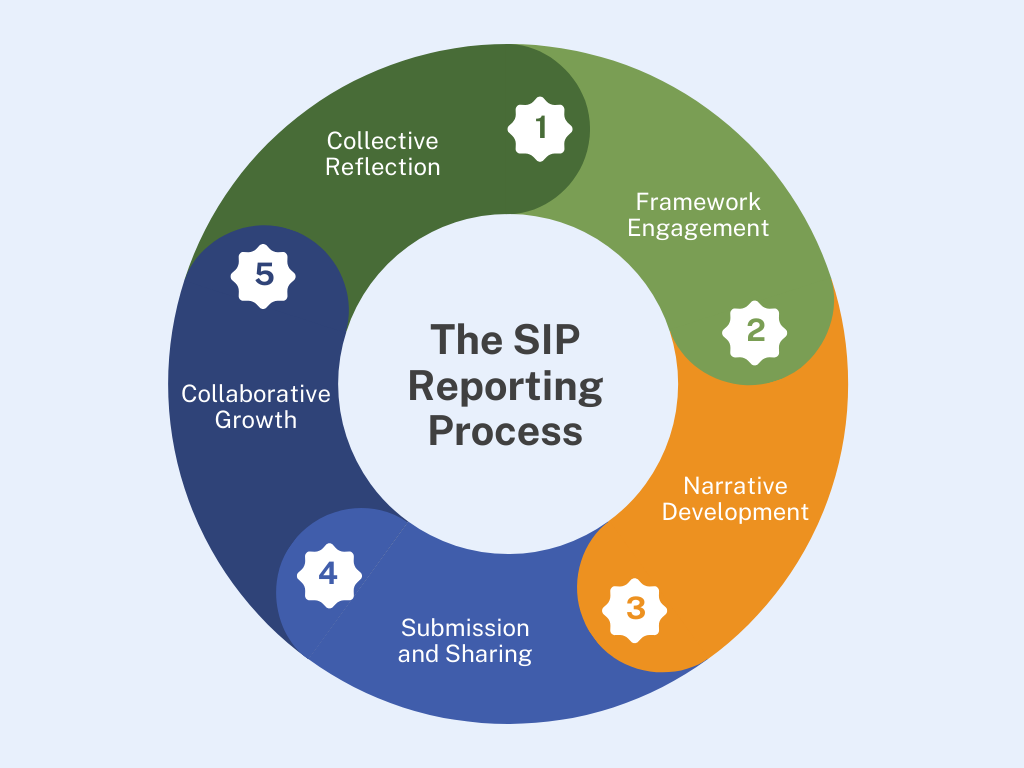
Prepare by reflecting collectively on current practice: Engage colleagues across the institution to surface how responsible management education is being enacted, where momentum exists, and where questions remain.
Structure reflection through the SIP framework: Use the SIP in PRME Commons to organize narratives and evidence in a way that is coherent, transparent, and grounded in institutional context.
Articulate an evidence-based institutional narrative: Collaboratively document priorities, practices, and outcomes, making visible work that can inform learning within the institution and across the PRME community.
Consolidate and share the institutional account: Review and submit the SIP as a collective statement of progress, creating a point of reference for dialogue, recognition, and connection.
Engage with peer practice to inform next steps: Draw on SIPs from other institutions to support comparative reflection, inspire adaptation, and guide future development in relation to shared values and diverse contexts
Hear what others in the PRME community have to say about SIP reporting:
Creating awareness of the mission of PRME and your commitment to it: "We believe that the actual preparation of the report itself can serve as a powerful catalyst for continued change and further recognition of the influence of PRME on campus. The more that people on campus know about how PRME relates to our mission, the more likely they are to take steps to shape activities and programmes that will be aligned with and driven by the Principles." Babson College, United States.
Giving a concise and comprehensive overall picture of your activities: "Preparation of the report has brought to light the impressive number of activities in our College that are PRME-related. Although I track many of these programmes and initiatives, it is always surprising, when seeing it all accumulated, to realise the breadth and scope of these activities, and the large number of faculty, students, administrators and staff involved." The Peter J. Tobin College of Business, St. John's University, United States.
Boosting visibility and reputation: "For us, preparing the PRME report has had tremendous benefits. We have found that the process of gathering data regarding progress and commitments in relation to PRME has made visible very powerful backstage initiatives that are definitively making changes when educating future managers. Therefore, for us PRME has been an instrument of public and social recognition of creative and treasured initiatives that colleagues have silently designed and implemented in order to form socially responsible managers and citizens." Universidad EAFIT, Colombia.
Organising and connecting relevant people across your organisation: "The reporting process has been exceedingly good at organising people who impact sustainability indicators. Because of the reporting process, regular meetings occurred between some of these parties and continue to occur with the future goal of improving our environmental management system." KU Leuven Faculty of Economics and Business, Belgium.
Defining direction and strategy: "This process has enabled valuable critical discussions on the topic of responsible management education and its role across the institution. Putting the report together creates involvement and the final report serves as a proof that PRME activities are conducted beyond the CBS Office of Responsible Management Education and across the organisation... It helps us define our direction and strategy." Copenhagen Business School, Denmark.
Tracking and benchmarking progress: "Completing the SIP report on a yearly basis has facilitated our ability to track our activities, capture and benchmark the breadth of initiatives across campus, and motivate faculty, staff and students to build on these experiences, encouraging them to take them to the next level." Bentley University, United States.
Identifying where more can be done: "We have been able to see the gaps and areas of improvement towards achievement of the Principles and set out improvement plans where we are not doing well. This has also created more awareness and closer engagement with the Principles." KCA University, Kenya.
Fostering a sense of achievement: "Our first audience for the report was internal; it was a way of documenting and celebrating some of the excellent work in which our colleagues are engaged. The more we all learn about the work of our colleagues, the greater the opportunities are for new collaborations between us, and this is at the very heart of our inter-disciplinary School." Glasgow Caledonian University, United Kingdom.
Creating new synergies and collaborations: "Our baseline report gives [readers] a primer on all of the various social impact initiatives and programmes at Berkeley-Haas, which accelerates the conversations we're able to have with our employees, advisors and students. We're able to spend less time explaining who we are and more time focusing on areas of collaboration and growth." The Haas School of Business, University of California Berkeley, United States.
Promoting PRME's impact globally: "Public reporting of SIP ensures the credibility of the PRME initiative and facilitates the exchange of good practices among the PRME network and beyond." Monash University Faculty of Business and Economics, Australia.
Thanks to the feedback received from our community, we have been able to implement a few updates for the 2026 cycle that we hope will improve the SIP report itself and the process of reporting.
Simplifying the Questionnaire
A few questions from the 2025 cycle, particularly within the Teach Principle, did not substantially provide reflection opportunities for the community nor did they adequately demonstrate responsible management education. As a result, we have removed 4 of these questions. We also removed the dependent question that asked for the extent that an affiliation advanced responsible management education as well as removing the dependent SDG question for the course evidence as many members of the community did not feel this level of detail provided any substantial information.
Goal Setting
We added one non-mandatory prompt under the Purpose Principle for Signatories to set their goals within the specific SIP cycle. This prompt is intended as a non-prescriptive intention-setting exercise that supports reflection rather than evaluation. Signatories are invited to articulate goals that reflect their current priorities, institutional strategy, and local context, whether these are well-established, emerging, or exploratory. Goals could be institution-wide or focused on specific programmes, themes, or initiatives, and do not need to be fully measurable, time-bound, or formally approved. This section is designed to help institutions clarify how the Principles or PRME inform their direction of travel and how engagement with the PRME community may support learning, collaboration, or progress over time. In future SIP cycles, Signatories will be invited to revisit these goals and reflect on any progress, setbacks, or pauses, and how these experiences inform priorities for the year ahead.
Reuse of Answers
PRME recognizes that progress in implementing RME can take time and does not happen all at once nor within one year. With the shift to an annual reporting period via a standardized questionnaire, we wanted to ensure the reporting itself also recognizes this aspect. Especially for many questions and prompts where an answer may not change for years such as the mission, vision, degree programmes, etc. As a result, those who are not reporting for the first time will be shown available answers from their past SIP that they may reuse. We expect our Signatories to review and make any necessary changes for questions and prompts that are more likely to see change year to year.
The only exception to this is the letter of commitment which requires new evidence to be uploaded annually.
Updates to Publication Evidence
To provide clarity, we changed the Conferences & Publications evidence to just Publications. There are no substantial changes to this evidence overall except asking for the impact factor of a journal if the publication is a peer-reviewed article and removing the dependent question when selecting relevant SDGs. These changes were made in an effort to make the evidence less confusing and more straightforward. Any legacy Conferences & Publications evidence will be updated as Publications evidence with no impacts to the data within them.
Set Up
Confirm institutional contact information in PRME Commons is up to date.
The focal point for every Signatory Member has access to PRME Commons. If your institution has experienced a recent faculty change that affects who is responsible for PRME-related matters, please update the contact's name, title, and email address ASAP. Please contact our team at info@unprme.org if you are not able to reset your password or would like to change the admin email used on your institution's PRME profile. This is also a good time to make sure other contacts, such as your highest executive and payment contact, are also up to date in your PRME profile.
Ensure the right team members have access to contribute or review the SIP.
Navigate to your organizational profile in Commons and with the members tab, invite colleagues and/or edit permissions.
Note key SIP deadlines and align them with internal planning and approval timelines.
The 2026 SIP reporting period is 1 March at 8:00 AM (ET) to 30 September at 11:59 PM (EDT).
New joiners do not need to submit a SIP until the year after joining. For example, Signatories joining PRME in 2026 do not need to submit a SIP until 2027.
Signatories, excluding new joiners, who fail to submit a SIP within the submission period will be listed as ‘Non-communicating’ on their Signatory profile.
‘Non-communicating’ Signatories who do not submit a late SIP by 31 December 2026 will be ‘Delisted’ from PRME in 2027.
Familiarize
Access the SIP preview to understand the structure, question flow, and required vs. optional sections.
Review the SIP tutorial to understand how to navigate Commons and submit the report.
Explore sample SIPs from 2025 to see different approaches from PRME Signatories to structure, depth, and use of evidence. These will be accessible via Commons.
Organize
Identify internal data and evidence sources (curriculum mapping, research outputs, partnerships, operations, student initiatives). There are helpful tips along the way of where some of this information can be found.
Assign responsibility across teams for different questions or Principles.
Gather existing materials that can be reused or adapted (previous SIPs, accreditation reports, SDG mappings).
Strategize
Clarify what you want to highlight this cycle (new initiatives, progress since last report, areas of learning or challenge).
Decide where narrative and images add value and where concise data or evidence is sufficient.
Plan time for internal reflection and review before final submission.
Step back and read the SIP as a complete story to see whether it clearly reflects your institution’s approach and priorities.
Equip to Learn
Identify peer institutions or regions to explore in PRME Commons for inspiration and benchmarking.
Consider how insights from this SIP cycle will inform next steps, including curriculum updates, partnerships, or strategy discussions.
Delegate! Creating a SIP is a lot of work. The “Invites” tab helps you to delegate evidence to colleagues and keep tabs of who is responsible for what.
Create a report view before submitting so you can visualize how it will look. You cannot edit the evidence once it is submitted so it’s important to make sure you have it how you want it to appear before submitting.
Utilize the “Continue telling your story” prompt as a chance to add narratives to the report that are not explicitly asked for in the questionnaire. This is a nod to the previous version of SIP reporting to ensure color and context and are not overlooked for standardization and data.
Submit section by section. Focus on one Principle or topic area at a time to keep momentum.
SIPs will be submitted via PRME Commons, to which all Signatory Members have access via their focal point. If you do not have access, please write to us at commons@unprme.org.
SIP reporting is required annually. The 2026 reporting period is 1 March at 8 AM (ET) to 30 September at 11:59 PM (EDT).
The deadline for the reporting period is 30 September. No extensions will be provided. You will still be able to submit past the 30 September deadline, but your institution will be marked as "Non-Communicating" from that date until your submission date (must be before or on 31 December annually) and will not be eligible for a SIP Award. Once you submit the report your status will be reverted to "Communicating".
Reporting applies to all PRME Signatories. New joiners will submit their first SIP report the year after they join.
While PRME Commons is structured around the calendar year for consistency in global reporting, we fully recognize that many university documents and policies are written for the academic year or span multiple academic years. This is a valid and important observation.
To that end, we are not requesting that institutions revise or reformat internal documents to fit the calendar year. Rather, we are asking that you share the policies, materials, and practices that were active during the calendar year in question—regardless of how those documents are dated or framed. If a policy or program spans multiple years but was in effect during the relevant calendar year, it is appropriate to include it.
Please answer each question in the way that best reflects your institution’s practices. Use your judgment to determine which documents most accurately represent your efforts during the suggested time period.
For the purpose of reporting the number of graduates as well as student enrollment, we recommend your previous academic year or main degree granting period.
Yes, you can access the 2026 SIP preview on our website.
We have a preview of the SIP, but encourage all members to work on their SIP within PRME Commons.
Signatories, excluding new joiners, who fail to submit a SIP within the submission period will be listed as ‘Non-communicating’ on their Signatory profile. ‘Non-communicating’ Signatories who do not submit a late SIP by 31 December will be ‘Delisted’ from PRME on 1 January the following year.
Signatories must answer all of the required questions and provide all the required evidence for each Principle to have a complete submission. The SIP preview will provide a comprehensive overview of what is required. Evidence requirements may change based on your question responses, and therefore required evidence can vary for each Signatory.
The time it takes to complete a SIP report varies widely across institutions. The reporting method via Commons is intended to be more direct and clear on what to report on, and could take more or less time than the previous reporting method, depending on the level of detail that is included.
Signatories can expect there to be more heavy lifting their first year, but they will be able to reuse answers the following years.
No. The intention of the new reporting model is to create a mechanism for measuring impact and self-progress, contributing to the development of our community.
To log into the Commons platform, please use the e-mail address you use to sign into your institution’s profile on the PRME website. An invitation to create an account on the platform should have been sent to this email address. If you have not received the invitation or are not able to log in, please email us at commons@unprme.org.
Yes, in fact, we encourage it! Focal points of Signatory Members have admin access to their institutional account on PRME Commons and can invite other users to the institutional account.
Admins:
Supervisors can:
Contributors can:
Members can:
Yes, you can work on your SIP report in stages and save as you go. However, once you submit your report you cannot edit it again.
All other Signatory Members will be able to see your answers to the questionnaire when you submit your SIP. However, you have the option to choose who views your objects and narratives. They can be set to private (only those who have access to your institutional account), PRME community only (only Signatory Members within PRME Commons), or public (anyone viewing the publicly shared SIP report).
Additionally, you can create various 'views' of your SIP report in your privacy settings to tailor to your various audiences.
You will be able to download your completed report once submitted. This download will include all of your objects and narratives, including the private ones visible only to you. The report uploaded to the PRME website will be the "public" view, and will only include objects and narratives that you have selected as public.
Note that you can change the viewing permissions on your objects and narratives after submission.
No events found