Access

- Submit your institution’s Sharing Information on Progress (SIP) Report
- Access SIP reporting across institutions

Access
Access

 New York, United States
Share


As a development economist working within a business school, Geri Mason’s pathway into PRME was both unconventional and deeply aligned with her academic purpose. Economists are still underrepresented in management education spaces, and development economics even more so. Yet Geri’s lifelong focus on poverty, sustainability, and human flourishing made PRME a natural fit, long before it became a formal framework at her institution.
Geri joined Seattle Pacific University (SPU) in 2010, just after the university became a PRME Signatory in 2008. SPU’s longstanding mission, grounded in a values‑based vision of business serving human flourishing, had already drawn her in. PRME, she recalls, “gave us this link to a global understanding of how we understood business.” It provided a shared language and global connection for work that was already embedded in the school’s core mission.
Through the PRME Champions, Geri Mason’s journey illustrates how individual passion, collective experimentation, and global collaboration can reshape classrooms, strengthen institutions, and expand what is possible in management education.
While Geri supported SPU’s decision to become a PRME Champion, her most intensive engagement with the Champions network came later, opening a new chapter of collaboration, experimentation, and leadership.
Champions as a Catalyst for Collaboration and Innovation
Joining the PRME Champions marked a turning point in Geri’s engagement. While she had long been active in the PRME Working Group on Anti-Poverty, becoming a Champion expanded her involvement across the broader PRME ecosystem. “Being part of the Champions is what got me involved with more facets of PRME,” she reflected. “It made me start thinking about the big picture.”
Through Champions convenings and collaborative sub‑projects, Geri formed deep and lasting relationships with faculty across institutions and disciplines, connections that continued even as colleagues moved institutions or rotated out of the network. “That smaller, more concentrated group led to really deep relationships. Those connections still matter to me today in terms of research, projects, and just trading ideas,” Geri shared.
One standout initiative was One Week to Save the World, a Champions‑led global studio design project in partnership with the University of Limerick. The project intentionally inverted traditional sustainability pedagogy by focusing on a local issue, unsheltered persons in Seattle, while bringing global perspectives to bear. “We spent a lot of time talking about whether it would work,” Geri recalled. “And then I thought, let’s just try it and see.”
Students from four universities across multiple regions, with representation from China, Vietnam, India, multiple countries in Europe, the US, Mexico, and Canada, collaborated across time zones using digital tools, engaging in a relay‑style workflow to propose system‑level interventions connected to multiple SDGs. Local policymakers, NGOs, legal experts, and community advocates provided grounding and feedback. “The ingenuity of the students was amazing,” Geri said. “And the experts were genuinely impressed by the depth and thoughtfulness of the ideas.”
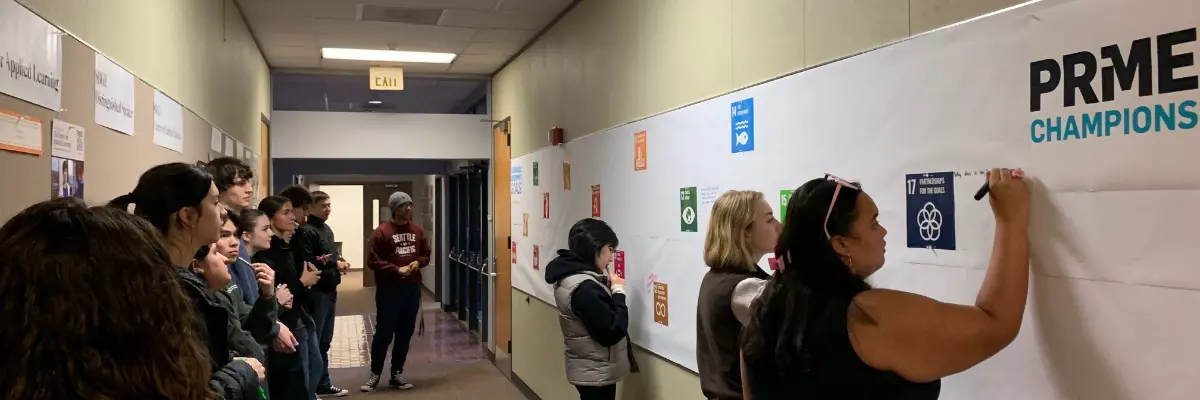
Institutionally, PRME Champions helped SPU better understand and articulate what was already central to its mission. Initiatives such as SDG of the Quarter spotlight a single SDG each term to foster campus-wide engagement. The SDG is integrated into faculty curricula, promoted through prompts, digital and print materials, and guest speakers, and reinforced through activities like classroom discussions, field trips, and an annual SDG Graffiti Wall. These efforts, along with curriculum mapping and broader SDG integration, make sustainability visible, accessible, and embedded across disciplines. “We realized how embedded this work already was,” Geri noted. “PRME gave us the language to tell the world who we are.”
As a smaller institution in the Champions network, SPU has also experienced PRME as a platform for amplification. Participation has opened doors to unexpected partnerships, including international pedagogical collaborations initiated specifically because of the university’s PRME affiliation. For example, Geri’s colleague collaborated with educators at Meiji University, Japan, and Lancaster University, UK, to develop an educational programme aimed at cultivating global leadership and problem-solving skills through exploratory learning on the SDGs.
Empowering Students Through Embedded Sustainability
For Geri, the most powerful impact of her PRME engagement has been its effect on students. Through the One Week to Save the World project organized through the Champions group, she observed a striking transformation in students’ confidence and sense of agency over a short period of time. Students moved from uncertainty to confidently articulating ideas, collaborating internationally, and advocating for systemic change. “You could actually see their sense of agency grow,” she shared.
Institution-wide engagement through PRME Champions reinforced sustainability across the curriculum. A comprehensive SDG mapping exercise confirmed that all 17 SDGs were already embedded in courses, meaning students encountered sustainability consistently within their majors rather than as a separate pathway. While a sustainability minor was launched, low student demand revealed the depth of this integration: sustainability was already central to the academic experience. This embedded approach shaped students’ academic identities and ensured that responsible management principles were part of everyday classroom practice, not confined to standalone programmes.
As SPU gears up for its fifth cycle as a PRME Champion, Geri is focused on scaling collaborative Champions models, strengthening engagement with regional PRME Chapters, and advancing research and teaching around regenerative sustainability, what she sees as the next horizon beyond the SDGs. “We’re not just going to stop teaching sustainability in 2030,” she said. “There has to be a vision for what comes next, and for me, that vision is regenerative sustainability.”
Through Geri’s journey with PRME, beginning with aligned research interests, expanding into international collaborations, and culminating in co‑authored publications, PRME has become a meaningful and formative part of her professional identity. It highlights the meaningful change that can happen when individual initiative and collective collaboration come together.
Share
New York, United States
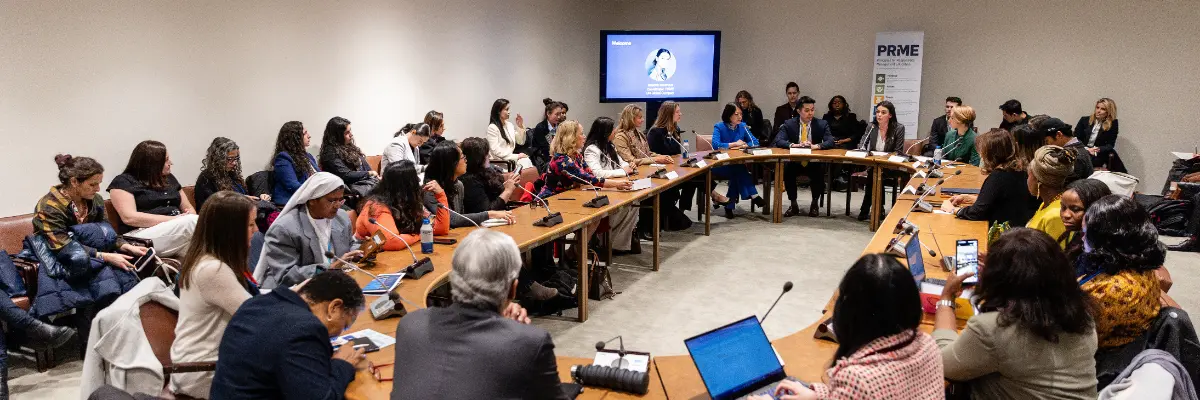
Igniting Women’s Innovation: Insights from CSW70 at the United Nations
 Fort Collins, United States
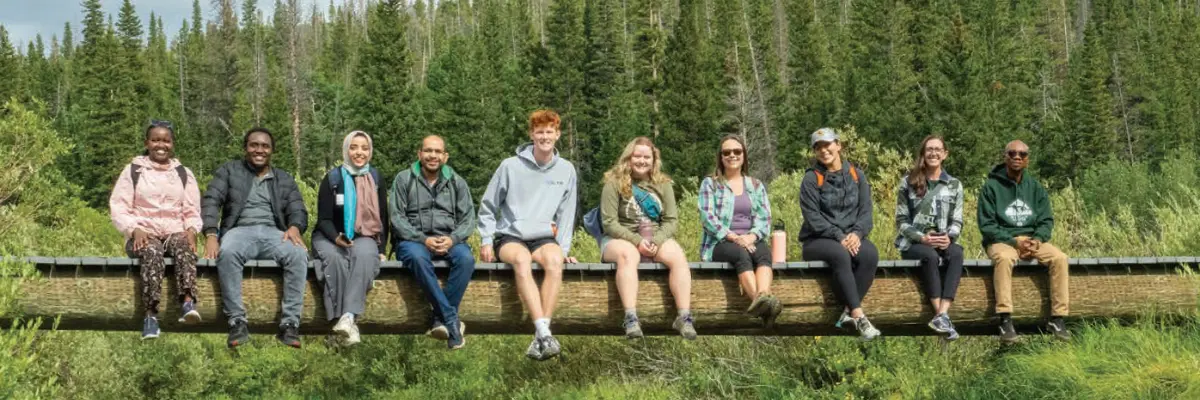
Signatory Spotlight: Colorado State University College of Business, US
 Saskatoon, Canada
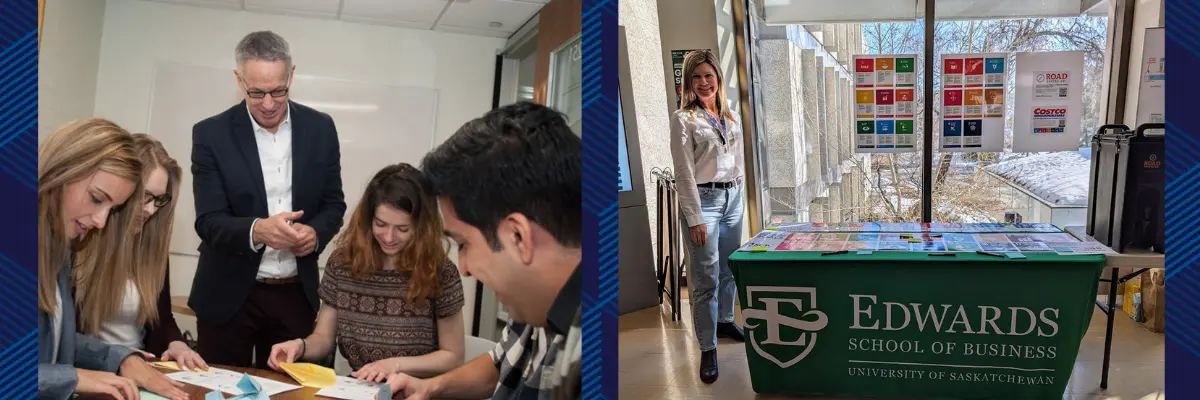
Signatory Spotlight: Edwards School of Business, University of Saskatchewan, Canada