Access

- Submit your institution’s Sharing Information on Progress (SIP) Report
- Access SIP reporting across institutions

Access
Access


 New York, United States
Share


For more than a decade, Judita Peterlin, Professor at the School of Economics and Business at the University of Ljubljana and a member of PRME Chapter Central and Eastern Europe (CEE), has engaged with PRME as a space for shared values, collective learning, and pedagogical experimentation. Through her participation in the 2025 PRME Pedagogy Certification series, she began to fundamentally rethink her role as an educator. Rather than focusing on delivering content, she shifted toward designing learning experiences that place relationships, curiosity, and human development at the center of management education.
This shift captures what Judita says changed most through PRME Pedagogy Certification: her understanding of what learning requires before content can truly land. As she reflected during the series, “I did not think about this before the training… I thought my main role was to transfer knowledge.”
Judita describes her PRME Pedagogy Certification experience as energizing, though initially overwhelming as she navigated the new digital tools. What sustained her was the learning environment created by the facilitators. “The sessions were always so nurturing and encouraged us to be like students.” That tone mattered. It created space for Judita to rethink teaching not as having the right answers, but as shaping the conditions for learning.
One prompt, repeated throughout the series, became a practical design compass: what do we want learners to experience? Judita recalled seeing this slide multiple times, accompanied by themes of relationship-centered learning and experiential engagement. Gradually, it reshaped how she saw her role, “Maybe my role now is more of being the bridge between the students and their future business world.”
She also began using the Principles of PRME as a checklist for curriculum design. “Now every time I design an exercise, I always go back and determine which activity corresponds to which Principle.” The result was not just new activities, but a deeper shift in identity and intention toward what she calls “communities of awe, wonder, and curiosity,” where educators do not need to have all the answers, but instead research with students, acting as facilitators rather than “talking heads,” and asking better questions.
Judita’s redesign of her Management for International Students course using her learnings from the pedagogy certification unfolded through two complementary transformations, each explicitly aligned with all Principles of PRME.
The first, reaching around 120 students, focused on community-building as a visible and repeatable classroom practice through birthday celebration rituals. A rotating “Ritual Manager” role placed students in charge of organizing celebrations, coordinating with peers, partnering with local businesses when appropriate, and creating zero-waste gifts rooted in student talents such as painting, music, or baking. What Judita once viewed as disruptive came to represent care. Judita was amazed by how a dedicated student volunteer, Tara, took on the responsibilities of a Ritual Manager - researching each student’s wishes and surprising them with the class’s good wishes and a small token to say, “we are happy you are with us.” Judita reflects, “I think that we need to show students we care for them as human beings, because then we will learn together and later on when students - future managers, will manage their staff they will care for others as well because they will carry with them the experience they have of being seen and worth of attention and cared for.” Judita watched this transform the classroom experience: strengthened belonging, psychological safety, and a reframing of management as relational work, where noticing people, creating rituals, and designing inclusive environments are core leadership practices.
The second transformation, reaching approximately 120 students, focused on academic rigor and research literacy through a reading club co-designed with library experts. In response to declining deep reading habits and increased reliance on low-quality sources, Judita embedded knowledge center librarians into weekly learning cycles. Students learned to navigate academic databases, select scientific papers, synthesize key concepts, and present their insights through posters featuring QR codes linking to full articles, along with contact details to encourage peer dialogue. For Judita, the goal was not simply more reading, but different reading. “When you have to read in order to then talk about it later on,” she explained, “you read more intentionally.”
The impact extended beyond students. The model strengthened collaboration between librarians and faculty as co-educators and supported the institution’s broader knowledge infrastructure. As Judita noted, when students do not use high-quality academic resources, subscriptions and funding can decline, “and then the next generation loses.” Across both transformations, the sequence remained consistent: belonging and trust first; rigor and research capability next.
Judita shared the reading club model with colleagues at the University of Ljubljana and co-facilitated a PRME Chapter CEE Solarpunk reading club with Marina Schmitz, Co-Vice Chair Chapter Chair; IEDC-Bled School of Management, drawing on a genre and movement focused on optimistic, sustainable futures, to test how the approach translates across disciplines and age groups. For her, the value lies as much in community as in content.
Judita’s story shows that curriculum transformation is not simply about redesigning syllabi or assessments. It is about rethinking the purpose of education itself. Through PRME, she moved from seeing herself as a transmitter of knowledge to a facilitator of learning communities. Her advice to others considering similar engagement is both practical and generous: take the first step, be gentle with yourself, and choose what fits your context. “Once you join the community,” she said, “you see that we are all learning all the time.”
Share
Eisenstadt, Austria
Turning Sustainability Data into Collaboration: PRME Chapter DACH and UN Global Compact Country Network Austria Meet in Eisenstadt, Austria
 Almaty, Kazakhstan
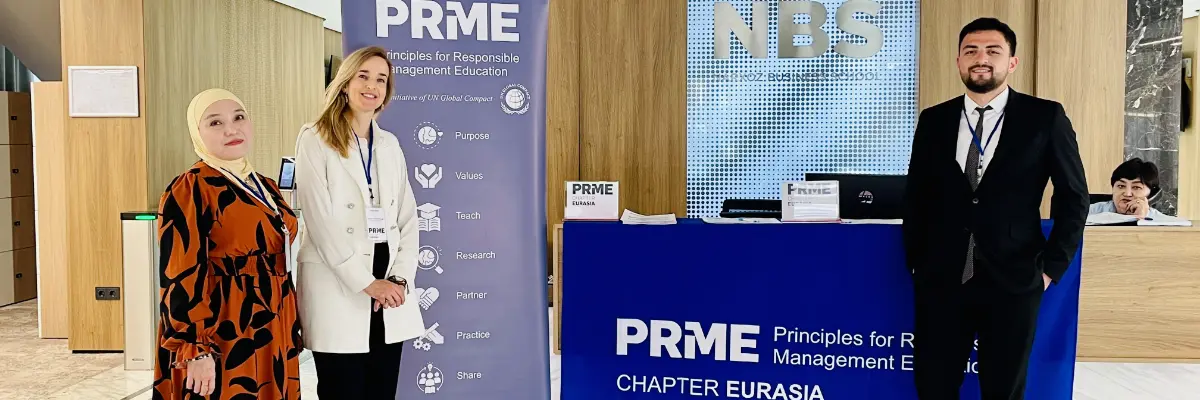
PRME Chapter Eurasia Holds Landmark Annual General Meeting in Almaty, Kazakhstan
 Lagos, Nigeria
Signatory Spotlight: Lagos Business School, Pan-Atlantic University, Nigeria