Access

- Submit your institution’s Sharing Information on Progress (SIP) Report
- Access SIP reporting across institutions

Access
Access


 Eisenstadt, Austria
Share


PRME Chapter DACH and the UN Global Compact Network Austria we're pleased to come together for an event at the University of Applied Sciences Burgenland in Eisenstadt, Austria, where participants explored how sustainability data can become a powerful catalyst for collaboration between academia and business.
After Lisa Fröhlich presented current developments within PRME and the growing activities of the PRME Chapter DACH, Josefine Kuhlmann introduced the university’s EU-funded projects and highlighted how applied research can support sustainable transformation.
A central highlight of the meeting was the presentation from Stefanie Weniger, Executive Director of the UN Global Compact Network Austria, on the 2025 Communication on Progress (CoP) analysis of Austrian companies in the United Nations Global Compact. The Communication on Progress is much more than a reporting requirement. It is a standardized data set that provides valuable insights into how companies are embedding the Ten Principles of the UN Global Compact into their business practices. The analysis illustrated where companies have already made substantial progress, where implementation gaps remain, and which sustainability topics are currently receiving the greatest attention. This makes the CoP a highly valuable source of information for identifying corporate priorities and transformation needs. It also demonstrated the significant potential of using these data strategically to support benchmarking, targeted capacity building, and more effective collaboration between business and academia.
Building on these insights, the plenary discussion explored how PRME and the UN Global Compact can combine their complementary strengths to turn CoP data into meaningful partnerships. Participants discussed the idea of a matchmaking platform that would connect companies and universities based on shared sustainability priorities, research interests, and SDG goals. Such a platform could increase transparency regarding which organizations are working on specific topics, facilitate the identification of suitable collaboration partners, and support the development of joint research projects, student initiatives, and executive education formats. At the same time, participants emphasized that alternative formats such as targeted webinars or thematic networking events may offer a pragmatic first step toward building stronger and more impact-oriented cooperation. In addition, the group highlighted that CoP data could be used more strategically to provide companies with a credible reference base for substantiating sustainability claims and preparing for the requirements of the EU’s Empowering Consumers for the Green Transition Directive (EmpCo).
The workshop clearly demonstrated that sustainability reporting should not be viewed as a compliance exercise alone. When used strategically, it can become a valuable knowledge base for research partnerships, innovative teaching, and joint projects that accelerate sustainable transformation.
Share
Eisenstadt, Austria
Turning Sustainability Data into Collaboration: PRME Chapter DACH and UN Global Compact Country Network Austria Meet in Eisenstadt, Austria
 Almaty, Kazakhstan
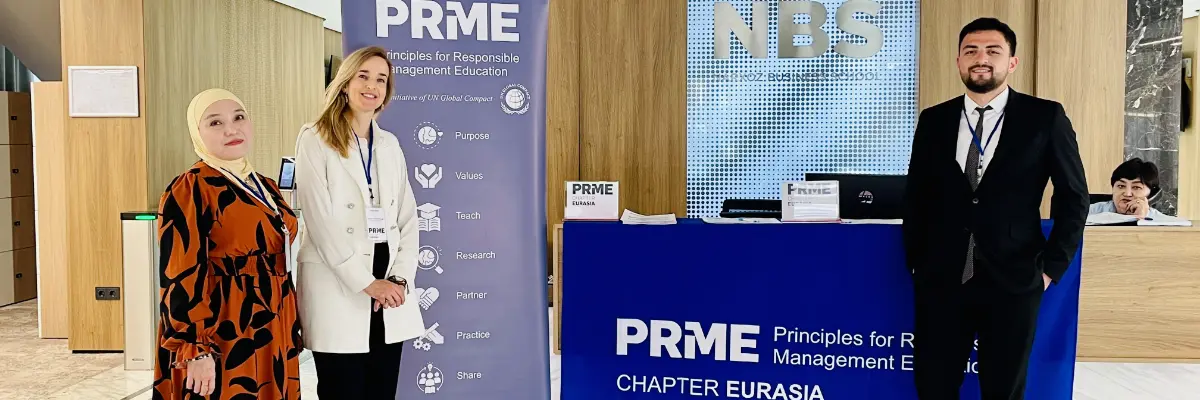
PRME Chapter Eurasia Holds Landmark Annual General Meeting in Almaty, Kazakhstan
 Lagos, Nigeria
Signatory Spotlight: Lagos Business School, Pan-Atlantic University, Nigeria