Access

- Submit your institution’s Sharing Information on Progress (SIP) Report
- Access SIP reporting across institutions

Access
Access

 New York, United States
Share


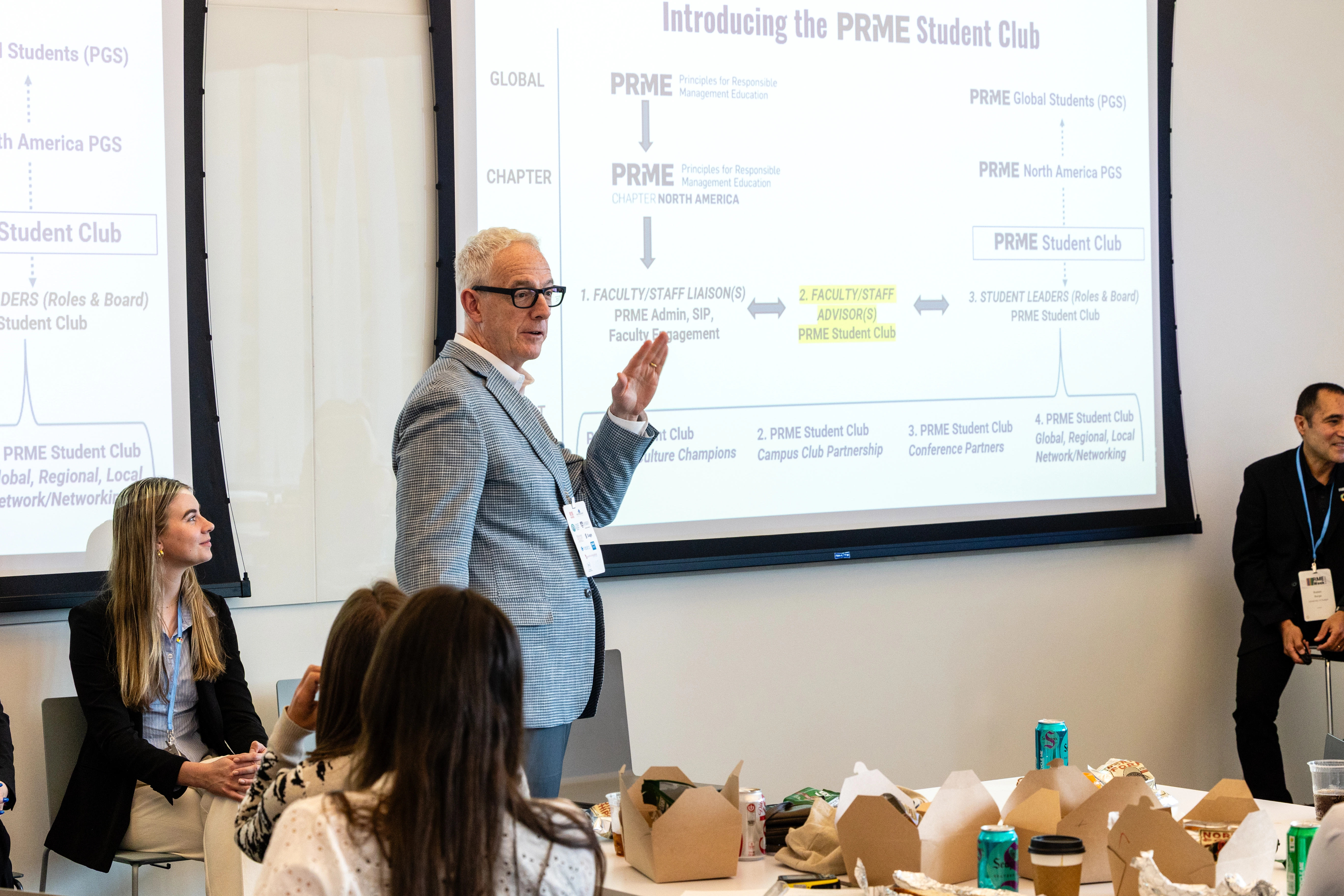
“I wanted to dedicate my career to seeing what business could do to advance the human condition and sustain this planet.” From his early doctoral research to his leadership within the PRME community, David Steingard has spent his career exploring how business can be a force for good. Inspired by visionary companies like Ben & Jerry’s and The Body Shop, he sought to understand how ethics, social responsibility, and entrepreneurship could converge to create meaningful societal impact. Today, as a professor at the Haub School of Business at Saint Joseph’s University, David’s mission reaches a global scale through the PRME community, connecting students, educators, and institutions worldwide.
PRME provides what David calls "a gossamer thread that connects all of the various activities that a professor engages - teaching, research, service, and external leadership.” This thread is woven from "the normative values foundation" rooted in the United Nations and the SDGs, creating "an actionable framework of human rights, sustainability, equality, and justice that are imperturbable and timeless.”
This philosophy underpins many aspects of his work. In teaching, he co-developed a pioneering undergraduate programme at the Haub School in Leadership, Ethics, and Organizational Sustainability, one of the few undergraduate degree programmes in the world that trains business students to intentionally create positive societal impact through business. Its capstone course exemplifies PRME’s experiential learning approach: students conduct real-world sustainability assessments and recommend strategies to help companies pursue B Corp certification, “translating classroom learning about ‘business as a force for good’ into demonstrable company impact.”
David observes two types of students: those already passionate about social impact and those newly introduced to the idea. Educating students within the context of the Principles of PRME, alongside the global association with the United Nations, creates a qualitative impact that goes beyond traditional business education. Many students only recognize this after experiencing it firsthand: “PRME provides students with legitimacy, structure, and opportunity, allowing them to engage in purpose-driven work that extends far beyond the classroom.”
Beyond teaching, David leverages the PRME network to advance research aligned with the SDGs and societal impact. Initiatives like the RRBM Honor Roll and the SDG Dashboard allow him to evaluate scholarship for both rigor and real-world relevance, revealing gaps and opportunities in business research. For example, David has found that “Life Below Water (SDG 14) is consistently one of the most neglected research areas for business schools.” “These and similar findings highlight the urgent need for new research directions that address pressing global challenges.”
David’s groundbreaking SDG Impact Intensity metric, “one of the first non-citation metrics for evaluating a journal’s societal impact,” has uncovered striking trends. For example, in a co-authored paper presented at the 2025 Academy of Management Annual Meeting, David shared how Management Information Systems Quarterly (MISQ) increased its integration of SDG-focused research by 425% over eight years.
David’s research is revealing a consistent and encouraging finding: scholars, editors, and publishers in the business school publishing ecosystem are “intentionally and measurably integrating societal impact into top academic publications. This heralds a clear signal that business school scholarship can indeed move the societal impact needle forward.”
David also highlighted the opportunities for international collaboration offered by PRME. “The opportunities for scholarly collaboration and global projects are unprecedented. I couldn’t have imagined this 15 years ago,” he shared, emphasizing how the network extends the reach and impact of collaborative research across borders.
According to David, what distinguishes PRME is its blend of “legitimacy and solidarity.” For students passionate about social change, “PRME demonstrates that they can channel their humanitarian values and sustainability commitments directly into their business education and careers—and that is catalytic.”
But PRME’s influence goes beyond the classroom and research. “You realize that while rooted in your own school and country, you are walking the same path with inspiring colleagues across the global PRME community,” he reflects. This shared purpose is “invigorating and sustains our momentum even in challenging times.”
For David, PRME shows how individual transformation can spark ripple effects far beyond a single classroom, campus, or country: “PRME shines as a beacon, advancing sustainable development and inspiring the next generation of responsible business leaders.”
Share
New York, United States
Bridging Research and Reality: A Collaboration for Sustainability Impact
 New York, United States
2026 PRME Students Sustainability Awards: Call for Applications
 New York, United States
Appointment of New Head of PRME: Dr. David Steingard